


Page 56 - Handout of Computer Architecture (1)..
P. 56
•  Operating Systems
                   •  Multiprocessor systems
                   •  Multithreading
                   •  Database systems
                   •  Parallel computing


               2.13.12 Short Exam Answer (Perfect for writing)

               Synchronization is a technique used to coordinate multiple processes or threads when accessing
               shared resources to avoid race conditions and ensure data consistency. It ensures mutual
               exclusion in the critical section using mechanisms such as locks, semaphores, and monitors.


               2.14 Instruction Execution Rate
               A processor is driven by a clock with a constant frequency f or, equivalently, a constant cycle time
               Ϯ, where Ϯ = 1/f.

               Define the instruction count, Ic, for a program as the number of machine instructions executed
               for that program until it runs to completion or for some defined time interval.

               Note that this is the number of instruction executions, not the number of instructions in the
               object code of the program. An important parameter is the average cycles per instruction (CPI)
               for a program.

               If all instructions required the same number of clock cycles, then CPI would be a constant value
               for a processor.

               However, on any given processor, the number of clock cycles required varies for different types

               of instructions, such as load, store, branch, and so on.

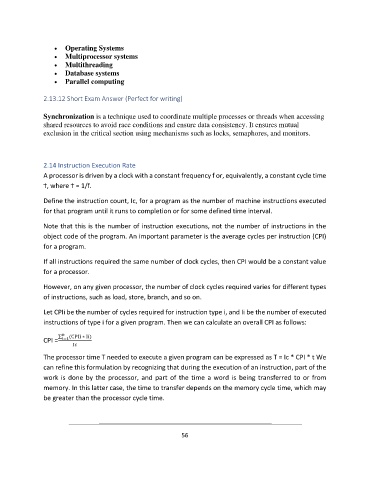
               Let CPIi be the number of cycles required for instruction type i, and Ii be the number of executed
               instructions of type i for a given program. Then we can calculate an overall CPI as follows:

                    ∑     (CPIi ∗ Ii)
               CPI =    =1

               The processor time T needed to execute a given program can be expressed as T = Ic * CPI * t We
               can refine this formulation by recognizing that during the execution of an instruction, part of the
               work is done by the processor, and part of the time a word is being transferred to or from
               memory. In this latter case, the time to transfer depends on the memory cycle time, which may
               be greater than the processor cycle time.


                                                             56

