


Page 67 - Handout of Computer Architecture (1)..
P. 67
where Trefi is the execution time of benchmark program i on the reference system and Tsuti is
               the execution time of benchmark program i on the system under test. Thus, ratios are higher for

               faster machines.

               3. Finally, the geometric mean of the 12 runtime ratios is calculated to yield the overall metric:

               =

               For the integer benchmarks, four separate metrics can be calculated:

               ■ SPECint2006: The geometric mean of 12 normalized ratios when the bench marks are compiled
               with peak tuning.

               ■ SPECint_base2006: The geometric mean of 12 normalized ratios when the benchmarks are
               compiled with base tuning.

               ■  SPECint_rate2006:  The  geometric  mean  of  12  normalized  throughput  ratios  when  the
               benchmarks are compiled with peak tuning.


               ■ SPECint_rate_base2006: The geometric mean of 12 normalized throughput ratios when the
               benchmarks are compiled with base tuning.

               The rate metrics take into account a system with multiple processors.

               To test a machine, a number of copies N is selected—usually this is equal to the number of
               processors or the number of simultaneous threads of execution on the test system.

               Each individual test program’s rate is determined by taking the median of three runs. Each run
               consists of N copies of the program running simultaneously on the test system.

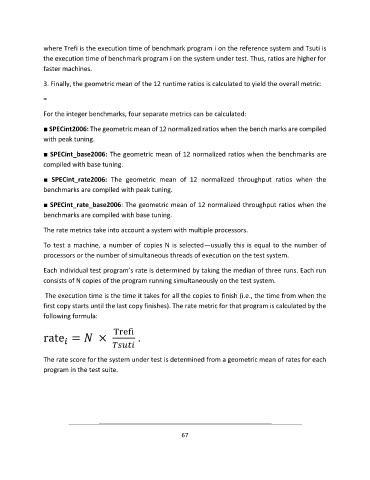
                The execution time is the time it takes for all the copies to finish (i.e., the time from when the
               first copy starts until the last copy finishes). The rate metric for that program is calculated by the
               following formula:


                                       Trefi
               rate =     ×                       .


               The rate score for the system under test is determined from a geometric mean of rates for each
               program in the test suite.


                                                             67

