


Page 4 - HaMizrachi Chanukah 5783 USA
P. 4
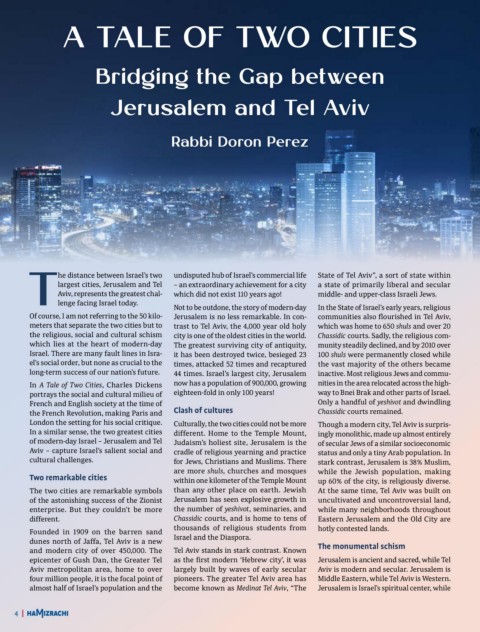
A TALE OF TWO CITIES


                         Bridging the Gap between


                            Jerusalem and Tel Aviv


                                           Rabbi Doron Perez


               he distance between Israel’s two   undisputed hub of Israel’s commercial life   State of Tel Aviv”, a sort of state within
               largest cities, Jerusalem and Tel   – an extraordinary achievement for a city   a state of primarily liberal and secular
               Aviv, represents the greatest chal-  which did not exist 110 years ago!   middle- and upper-class Israeli Jews.
        Tlenge facing Israel today.
                                            Not to be outdone, the story of modern-day   In the State of Israel’s early years, religious
        Of course, I am not referring to the 50 kilo-  Jerusalem is no less remarkable. In con-  communities also flourished in Tel Aviv,
        meters that separate the two cities but to   trast to Tel Aviv, the 4,000 year old holy   which was home to 650 shuls and over 20
        the religious, social and cultural schism   city is one of the oldest cities in the world.   Chassidic courts. Sadly, the religious com-
        which lies at the heart of modern-day   The greatest surviving city of antiquity,   munity steadily declined, and by 2010 over
        Israel. There are many fault lines in Isra-  it has been destroyed twice, besieged 23   100 shuls were permanently closed while
        el’s social order, but none as crucial to the   times, attacked 52 times and recaptured   the vast majority of the others became
        long-term success of our nation’s future.  44 times. Israel’s largest city, Jerusalem   inactive. Most religious Jews and commu-
        In A Tale of Two Cities, Charles Dickens   now has a population of 900,000, growing   nities in the area relocated across the high-
        portrays the social and cultural milieu of   eighteen-fold in only 100 years!   way to Bnei Brak and other parts of Israel.
        French and English society at the time of                               Only a handful of yeshivot and dwindling
        the French Revolution, making Paris and   Clash of cultures             Chassidic courts remained.
        London the setting for his social critique.   Culturally, the two cities could not be more   Though a modern city, Tel Aviv is surpris-
        In a similar sense, the two greatest cities   different. Home to the Temple Mount,   ingly monolithic, made up almost entirely
        of modern-day Israel – Jerusalem and Tel   Judaism’s holiest site, Jerusalem is the   of secular Jews of a similar socioeconomic
        Aviv – capture Israel’s salient social and   cradle of religious yearning and practice   status and only a tiny Arab population. In
        cultural challenges.                for Jews, Christians and Muslims. There   stark contrast, Jerusalem is 38% Muslim,
                                            are more shuls, churches and mosques   while the Jewish population, making
        Two remarkable cities               within one kilometer of the Temple Mount   up 60% of the city, is religiously diverse.
        The two cities are remarkable symbols   than any other place on earth. Jewish   At the same time, Tel Aviv was built on
        of the astonishing success of the Zionist   Jerusalem has seen explosive growth in   uncultivated and uncontroversial land,
        enterprise. But they couldn’t be more   the number of yeshivot, seminaries, and   while many neighborhoods throughout
        different.                          Chassidic courts, and is home to tens of   Eastern Jerusalem and the Old City are
                                            thousands of  religious  students  from   hotly contested lands.
        Founded in 1909 on the barren sand
        dunes north of Jaffa, Tel Aviv is a new   Israel and the Diaspora.
        and modern city of over 450,000. The   Tel Aviv stands in stark contrast. Known   The monumental schism
        epicenter of Gush Dan, the Greater Tel   as the first modern ‘Hebrew city’, it was   Jerusalem is ancient and sacred, while Tel
        Aviv metropolitan area, home to over   largely built by waves of early secular   Aviv is modern and secular. Jerusalem is
        four million people, it is the focal point of   pioneers. The greater Tel Aviv area has   Middle Eastern, while Tel Aviv is Western.
        almost half of Israel’s population and the   become known as Medinat Tel Aviv, “The   Jerusalem is Israel’s spiritual center, while


    4  |

