


Page 2 - 2015 Best Practices of Spectacle Lens Management
P. 2
Full-time
               Table of
 Part-time    Contents       Introduction ............................................................................................................................2

                             Capture Rate............................................................................................................................3
                                                         % Contact Lens
                             Product Mix..............................................................................................................................8
                                                         Patients
                             Patient Profiling and Lens Recommendations........................................................................21
                             Retail Pricing..........................................................................................................................28

                             Eyewear Purchase Cycle.........................................................................................................31
                             Transaction Costs and Re-makes............................................................................................35
                             Patient Satisfaction................................................................................................................37
                                                                        50%
                             Getting Started: Adopting Best Practices..............................................................................39
                                                                        35%
                             Appendix................................................................................................................................41
                                                                        30%
                                                                        25%
                                                                        20%
               Note on     Data on optical industry and optometric practice norms is derived from many sources, including the Management & Business Academy™
         Sources Cited     (MBA), sponsored by Essilor; Jobson Optical Research; The Vision Council’s VisionWatch research program and a large body of proprietary
                           research conducted by Essilor. MBA data is derived from an ongoing research program that encompasses performance and processes
                           information from more than 1,900 U.S. optometric practices, gathered since 2005.

     Introduction          In most optometric offices, the largest single source of revenue is eyeglasses sales, typically producing 40 to 50 percent of total practice revenue.
                           Beyond patients’ desire to have their eye health regularly monitored, the primary reason most patients visit an optometrist is to purchase a pair
                           of eyeglasses. Prescribing eyeglasses is the major service provided by most optometric practices, with the largest impact on revenue and profit.

                                                                        The spectacle lens component of a pair of eyeglasses produces about
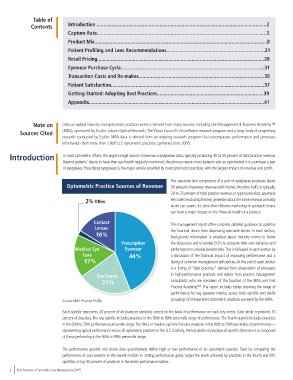
                             Optometric Practice Sources of Revenue     50 percent of eyewear revenue (with frames the other half), or typically,
                                                                        20 to 25 percent of total practice revenue. In typical practices, spectacle
                                     2% Other                           lens sales (excluding frames) generate about the same revenue annually
                                                                        as do eye exams. It’s clear that effective marketing of spectacle lenses
                                                                        can have a major impact on the financial health of a practice.
                                        Contact                         This management report offers concrete, detailed guidance to optimize
                                         Lenses                         the financial return from dispensing spectacle lenses. In each section,
                                         16%                            background information is provided about industry norms to frame

                                                    Prescription        the discussion and to enable ECPs to compare their own behavior and
                                Medical Eye          Eyewear            performance to reliable benchmarks. This is followed in each section by
                                    Care               44%              a discussion of the financial impact of improving performance and a
                                    17%                                 listing of common management deficiencies. At the end of each section
                                            21%
                                                                        is a listing of “best practices” derived from observation of processes
                                          Eye Exams                     in high-performance practices and advice from practice management
                                            21%                         consultants who are members of the faculties of the MBA and First
                                                                        Practice Academy™. The report includes tables showing the range of
                                                                        performance for key eyewear metrics across both quintile and decile
                           Source: MBA Practice Profile                 groupings of independent optometric practices surveyed by the MBA.
                           Each quintile represents 20 percent of all practices sampled, sorted on the basis of performance on each key metric. Each decile represents 10
                           percent of practices. The top quintile includes practices in the 80th to 99th percentile range of performance. The fourth quintile includes practices
                           in the 60th to 79th performance percentile range. The third, or median, quintile includes practices in the 40th to 59th percentile of performance—
                           representing typical performance across all optometric practices in the U.S. Similarly, the top decile of practices of specific dimensions is composed
                           of those performing in the 90th to 99th percentile range.

                           The performance quintile and decile data quantitatively define high or low performance of an optometric practice. Start by comparing the
                           performance of your practice to the overall median. In setting performance goals, target the levels achieved by practices in the fourth and fifth
                           quintiles, or top 30 percent of practices in the decile performance tables.
     2  Best Practices of Spectacle Lens Management 2015

