


Page 4 - 2015 Best Practices of Spectacle Lens Management
P. 4
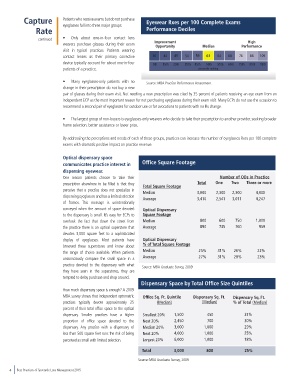
Capture         Patients who receive exams but do not purchase   Eyewear Rxes per 100 Complete Exams

                Rate       eyeglasses fall into three major groups:  Performance Deciles

                 continued  •  Only about one-in-four contact lens   Improvement                         High
                           wearers  purchase  glasses  during  their  exam   Opportunity  Median      Performance
                           visit in typical practices. Patients wearing
                           contact  lenses  as  their  primary  corrective   30  44  49  54  59  61  64  68  76  88  109
                           device typically account for about one-in-four     5th       15th      25th       35th     45th       50th       55th      65th      75th      85th      95th
                           patients of a practice.                                  percentile ranking

                           •   Many eyeglasses-only patients with no   Source: MBA Practice Performance Assessment
                           change in their prescription do not buy a new
                           pair of glasses during their exam visit. Not needing a new prescription was cited by 35 percent of patients receiving an eye exam from an
                           independent ECP as the most important reason for not purchasing eyeglasses during their exam visit. Many ECPs do not use the occasion to
                           recommend a second pair of eyeglasses for outdoor use or for avocations to patients with no Rx change.

                           •       The largest group of non-buyers is eyeglasses-only wearers who decide to take their prescription to another provider, seeking broader
                           frame selection, better assistance or lower price.

                           By addressing the perceptions and needs of each of these groups, practices can increase the number of eyeglasses Rxes per 100 complete
                           exams with dramatic positive impact on practice revenue.

                           Optical dispensary space
                           communicates practice interest in   Office Square Footage
                           dispensing eyewear.
                           One reason patients choose to take their                          Number of ODs in Practice
                           prescription elsewhere to be filled is that they   Total Square Footage  Total  One        Two       Three or more
                           perceive that a practice does not specialize in   Median  3,000  2,300  2,300    4,000
                           dispensing eyeglasses and has a limited selection   Average  3,410  2,541  3,011  4,247
                           of frames.  This message is unintentionally
                           conveyed when the amount of space devoted   Optical Dispensary
                           to the dispensary is small. It’s easy for ECPs to   Square Footage
                           overlook the fact that down the street from   Median      800     600   750      1,000
                           the practice there is an optical superstore that   Average  890   735   760       959
                           devotes 3,000 square feet to a sophisticated
                           display of eyeglasses. Most patients have   Optical Dispensary
                           browsed these superstores and know about   % of Total Square Footage
                           the range of choice available.  When patients   Median   25%     31%    26%       22%
                           unconsciously compare the small space in a   Average     27%     31%    28%       23%
                           practice devoted to the dispensary with what
                                                            Source: MBA Graduate Survey, 2009
                           they  have  seen  in  the  superstores,  they  are
                           tempted to delay purchase and shop around.
                                                            Dispensary Space by Total Office Size Quintiles
                           How much dispensary space is enough? A 2009
                           MBA survey shows that independent optometric   Office Sq. Ft. Quintile   Dispensary Sq. Ft.   Dispensary Sq. Ft.
                           practices typically devote approximately 25   (Median)    (Median)     % of Total (Median)
                           percent of their total office space to the optical
                           dispensary. Smaller practices have a higher   Smallest 20%  1,500  450      31%
                           proportion of office space devoted to the   Next 20%  2,450  700            30%
                           dispensary.  Any practice with a dispensary of   Median 20%  3,000  1,000   29%
                           less than 500 square feet runs the risk of being   Next 20%  4,000  1,000   25%
                           perceived as small with limited selection.   Largest 20%  6,000  1,000      18%

                                                            Total                3,000                    800                            25%
                                                           Source: MBA Graduate Survey, 2009

     4  Best Practices of Spectacle Lens Management 2015

