


Page 3 - 2015 Best Practices of Spectacle Lens Management
P. 3
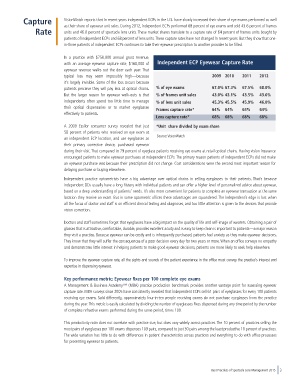
Capture          VisionWatch reports that in recent years independent ECPs in the U.S. have slowly increased their share of eye exams performed as well

                Rate        as their share of eyewear unit sales. During 2012, independent ECPs performed 68 percent of eye exams and sold 43.6 percent of frames
                            units and 46.0 percent of spectacle lens units. These market shares translate to a capture rate of 64 percent of frames units bought by
                            patients of independent ECPs and 68 percent of lens units. These capture rates have not changed in recent years. But they show that one-
                            in-three patients of independent ECPs continues to take their eyewear prescription to another provider to be filled.

                            In a practice with $750,000 annual gross revenue,
                            with an average eyewear capture rate, $160,000 of   Independent ECP Eyewear Capture Rate
                            eyewear revenue walks out the door each year. That
                            typical loss may seem impossibly high—because                 2009  2010  2011   2012
                            it’s largely invisible. Some of the loss occurs because
                            patients perceive they will pay less at optical chains.   % of eye exams   67.0% 67.3%   67.5%   68.0%
                            But the larger reason for eyewear  walk-outs is that   % of frames unit sales   43.0% 43.1%   43.5%   43.6%
                            independents often spend too little time to manage   % of lens unit sales   45.3% 45.5%   45.9%   46.0%
                            their  optical  dispensaries  or  to  market  eyeglasses   Frames capture rate*   64%  64%   64%   64%
                            effectively to patients.
                                                                  Lens capture rate*      68%  68%    68%    68%
                            A 2009 Essilor consumer survey revealed that just   *Unit  share divided by exam share
                            58 percent of patients who received an eye exam at
                            an independent ECP location, and use eyeglasses as   Source: VisionWatch
                            their  primary  corrective device, purchased  eyewear
                            during their visit. That compared to 79 percent of eyeglass patients receiving eye exams at retail optical chains. Having vision insurance
                            encouraged patients to make eyewear purchases at independent ECPs. The primary reason patients of independent ECPs did not make
                            an eyewear purchase was because their prescription did not change. Cost considerations were the second most important reason for
                            delaying purchase or buying elsewhere.
                            Independent practice optometrists have a big advantage over optical chains in selling eyeglasses to their patients. That’s because
                            independent ODs usually have a long history with individual patients and can offer a higher level of personalized advice about eyewear,
                            based on a deep understanding of patients’ needs. It’s also more convenient for patients to complete an eyewear transaction at the same
                            location they receive an exam. But in some optometric offices these advantages are squandered. The independent’s edge is lost when
                            all the focus of doctor and staff is on efficient clinical testing and diagnoses, and too little attention is given to the devices that provide
                            vision correction.

                            Doctors and staff sometimes forget that eyeglasses have a big impact on the quality of life and self-image of wearers. Obtaining a pair of
                            glasses that is attractive, comfortable, durable, provides excellent acuity and is easy to keep clean is important to patients—a major reason
                            they visit a practice. Because eyewear can be costly and is infrequently purchased, patients feel anxiety as they make eyewear decisions.
                            They know that they will suffer the consequences of a poor decision every day for two years or more. When an office conveys no empathy
                            and demonstrates little interest in helping patients to make good eyewear decisions, patients are more likely to seek help elsewhere.

                            To improve the eyewear capture rate, all the sights and sounds of the patient experience in the office must convey the practice’s interest and
                            expertise in dispensing eyewear.

                            Key performance metric: Eyewear Rxes per 100 complete eye exams
                            A Management & Business Academy™ (MBA) practice production benchmark provides another vantage point for assessing eyewear
                            capture rate. MBA surveys since 2005 have consistently revealed that independent ECPs sell 61 pairs of eyeglasses for every 100 patients
                            receiving eye exams. Said differently, approximately four-in-ten people receiving exams do not purchase eyeglasses from the practice
                            during the year. This metric is easily calculated by dividing the number of eyeglasses Rxes dispensed during any time period by the number
                            of complete refractive exams performed during the same period, times 100.

                            This productivity ratio does not correlate with practice size, but does vary widely across practices. The 10 percent of practices selling the
                            most pairs of eyeglasses per 100 exams dispenses 109 pairs, compared to just 30 pairs among the least productive 10 percent of practices.
                            The wide variation has little to do with differences in patient characteristics across practices and everything to do with office processes
                            for presenting eyewear to patients.


                                                                                         Best Practices of Spectacle Lens Management 2015  3

