


Page 33 - 2017_HNO_IRQ_web_Neat
P. 33
PART II: INfORMATION gAPs & AssEssMENT PLANNINg


           INFORMATION GAPS & ASSESSMENT PLANNING


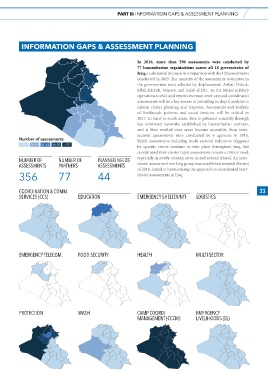
                                                              In 2016, more  than 350 assessments were conducted by
                                                              77  humanitarian organizations across all 18 governorates of
                                                              Iraq, a substantial increase in comparison with the 120 assessments
                                                              conducted in 2015. The majority of the assessments took place in
                                                              the governorates most affected by displacement: Anbar, Dahuk,
                                                              Erbil, Kirkuk, Ninewa, and Salah al-Din. As the Mosul military
                                                              operations unfold and returns increase, inter-sectoral coordinated
                                                              assessments will be a key means of providing in-depth analysis to
                                                              inform cluster planning and response. Assessment and analysis
                                                              of livelihoods patterns and social tensions will be critical in
                                                              2017. In hard-to-reach areas, data is gathered remotely through
                                                              key informant networks established by humanitarian partners,
                                                              and is then verified once areas become accessible. Four inter-
                                                              sectoral assessments were conducted by 6 agencies in 2016.
          Number of assessments                               Rapid assessments including multi-sectoral indicators triggered
                                                              by specific events continue to take place throughout Iraq, but
          <36  36–40 41–45  46–50  >50
                                                              coordinated inter-cluster rapid assessments remain a critical need,
                                                              especially in newly-retaken areas in and around Mosul. An inter-
         NUMBER OF         NUMBER OF         PLANNED NEEDS    cluster assessment working group was established towards the end
         ASSESSMENTS       PARTNERS          ASSESSMENTS
                                                              of 2016, aimed at harmonizing the approach to coordinated inter-
         356               77                44               cluster assessments in Iraq.


          COORDINATION & COMM.                                                                                      33
          SERVICES (CCS)            EDUCATION                 EMERGENCY SHELTER/NFI     LOGISTICS


          EMERGENCY TELECOM.        FOOD SECURITY             HEALTH                    MULTI-SECTOR


          PROTECTION                WASH                      CAMP COORD/               EMERGENCY
                                                              MANAGEMENT (CCCM)         LIVELIHOODS (EL)

