


Page 29 - 2017_HNO_IRQ_web_Neat
P. 29
PART II: MuLTI-PuRPOSe CASH ASSISTANCe


           MULTI-PURPOSE CASH ASSISTANCE


          OVERVIEW                                            NO. OF PEOPLE IN NEED     BY SEX       BY AGE
                   An estimated 3 million people have been and remain
                   displaced since January 2014 . The resources of many
                                         1
                   local communities hosting displaced families are  2.2M                50% 50%     47% 48% 5%
                                                                                          male
                                                                                             female
                   overburdened by this additional population, which is                              children adult elderly
          often too large for local economies to support. The limited financial                      (<18 yrs) (18-59) (>59)
          resources of displaced families are largely spent on essential items,
          such as food, water, transport, and rent. Iraq’s household expenditure
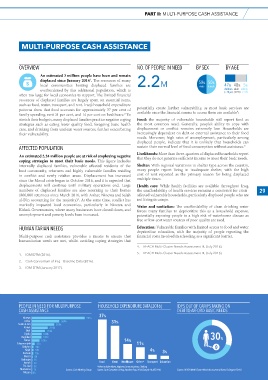
          patterns show that food accounts for approximately 37 per cent of   potentially create further vulnerability, as most basic services are
                                                                                                          4
          family spending, rent 31 per cent, and 14 per cent on healthcare.  To   available once the financial means to access them are available :
                                                        2
          stretch their budgets, many displaced families practice negative coping   Food: the majority of vulnerable households still report food as
          strategies such as eating lower quality food, foregoing basic health   the most common need. Generally, people’s ability to cope  with
          care, and drinking from unclean water sources, further exacerbating   displacement or conflict remains extremely low. Households are
          their vulnerability.                                increasingly dependent on debt or external assistance to their food
                                                              needs. Moreover, high rates of unemployment, particularly among
                                                              displaced people, indicate that it is unlikely that households can
          AFFECTED POPULATION                                 sustain their normal level of food consumption without assistance. 5
                                                              Livelihoods: More than three-quarters of displaced households report
          An estimated 2.24 million people are at risk of employing negative   that they do not generate sufficient income to meet their basic needs.
          coping strategies to meet their basic needs. This figure includes
          internally displaced families, vulnerable affected residents of the   Shelter: With regional variations in shelter type across the country,
          host community, returnees and highly vulnerable families residing   many people report living in inadequate shelter, with the high
          in conflict and newly retaken areas. Displacement has increased   cost of rent reported as the primary reason for being displaced
          since the Mosul crisis began in October 2016, and it is expected that   multiple times.
          displacements will continue until military operations end. Large   Health  care:  While health facilities are available throughout Iraq,
          numbers of displaced families are also returning to their homes   the unaffordability of health services remains a constraint for crisis-  29
          (800,000 returnees since March 2016, with Anbar, Ninewa and Salah   affected vulnerable households, particularly displaced people who are
          al-Din accounting for the majority) . At the same time, conflict has   not living in camps.
                                    3
          markedly impacted local economies, particularly in Ninewa and   Water and sanitation: The unaffordability of clean drinking water
          Kirkuk Governorates, where many businesses have closed down, and   forces many families to deprioritize this as a household expense,
          unemployment and poverty levels have increased.     potentially exposing people to a high risk of waterborne disease as
                                                              free or low-cost water sources of poor quality are used.

          HUMANITARIAN NEEDS                                  Education: Vulnerable families with limited access to food and water
                                                              deprioritize education, with the majority of people reporting the
          Multi-purpose cash assistance provides a means to ensure that   financial costs involved in schooling as a significant barrier.
          humanitarian needs are met, whilst avoiding coping strategies that
 RRM                                                CASH WORKING GROUP
                                                              4.   ReACH Multi-Cluster Needs Assessment III, (July 2016).
                                                              5.   ReACH Multi-Cluster Needs Assessment III, (July 2016).
          1.   IOM/DTM (2016).
          2.   Cash Consortium of Iraq – Baseline Data (2016).
          3.   IOM-DTM (January 2017).


 PEOPLE IN NEED  CHILDREN  DISPLACED PEOPLE IN NEED   PEOPLE IN NEED FOR MULTIPURPOSE  HOUSEHOLD EXPENDITURE DATA (2016)  IDPS OUT OF CAMPS TAKING ON
         CASH ASSISTANCE                                                        DEBT TO AFFORD BASIC NEEDS
 1 out of 2                                  37%
 Ninewa  1.3M  Ninewa                  711k
            Anbar           369k                   31%
 displaced is a child  Salah al-Din  301k
 Anbar  300k  Kirkuk   214k
            Erbil
 11%        Diyala  130k 174k
 Salah Al din  156k  Baghdad  127k
            Dahuk  101k                                 14%                                   30%
         Sulaymaniyah  37k                                    11%
 Dohuk  132k  Babylon  20k
            Najaf  18k                                              4%   3%
 Erbil   128k  of the people in need will  Kerbala  15k
            Wassit
                8k
 be displaced in 2017   Qadissiya  7k
            Basrah                           Food  Rent  Healthcare  Other*  Transport  Education
 Kirkuk  100k   2k
           Thi-Qar  2k                      *Other includes Water, Hygiene,Communications, Clothing
 Source: RRM Data 2016  Source: OCHA  Muthanna  1k  Source: Cash Working Group  Source: Cash Consortium of Iraq, Baseline Data, 2016 (Sample 14,453 HHs)  Source: REACH Multi-Cluster Needs Assessment, Round 3 (August 2016)
           Missan  1k

