


Page 26 - 2017_HNO_IRQ_web_Neat
P. 26
PART II: EdUCATION


           EDUCATION


          OVERVIEW                                            NO. OF PEOPLE IN NEED     SEVERITY MAP   -      +
                   Iraqi children are impacted by ongoing crises
                   throughout the country. Millions of Iraqi children have
                   missed out on formal education as a result of conflict,  3.5M
                   which has led to hundreds  of  schools being  damaged,
                   destroyed or occupied. In mid-2014, when ISIL took
          control of Mosul, over 2,400 schools were fully functional. As of   BY SEX  BY AGE
          January 2017, some 90 per cent of the 400 schools in newly accessible
          areas required rehabilitation. Additional January 2017 assessments
          in Ninewa found that over 35 per cent of schools were used by ISIL   53% 47%
          as military positions, weapons stores, and for teaching and training   male  female  100%
                                                                           children
          of children. Thirty-two per cent of school principals in Al-Qayyarah   (<18 yrs)
          reported concerns of explosive hazards in and around the schools.
          Remaining school facilities are overcrowded and under-staffed,   significant support, including winterization facilities, books, and
          significantly reducing the quality of education available. Moreover,   additional materials to ensure a basic quality of education. All recent
          displaced children often face additional challenges due to differences   assessments  implemented  in  newly-retaken  areas  highlighted  similar
          in language and curriculum used in areas of displacement, as well as   needs: rehabilitation of WASH facilities in schools; minor repairs of
          financial and transport constraints.                school infrastructure (windows, doors, electricity and heating systems);
                                                              mine risk education; replacement of teaching and learning materials;
                                                              and psychosocial support for students and teachers.
          AFFECTED POPULATION
                                                              There are numerous barriers preventing access to education for
          Over 3.7 million school-age children are affected by Iraq’s current   displaced children.  Many  schools  face  a  shortage  of  teachers  and
          crises. This includes over 1.4 million displaced children and 1 million   physical space. Moreover, across Iraq, 45 per cent of conflict affected
          children in host communities affected by the influx of displaced people   children are not attending school because their parents are unable to
          and conflict. It also includes 597,200 children who have recently   cover the cost of learning materials or school transport costs. In the
  26      returned to their homes following displacement, or in areas that have   KR-I, displaced children are  required to  enrol in  schools specifically
          recently come under Government control, and a further 105,000   established by the federal Government’s Ministry of Education, as
          children in conflict areas that are not currently under Government   local schools operate using a different language and curriculum. The
          control. All affected children have witnessed violence and suffered   long distances to education facilities, coupled with the increasing use
          disruption to their learning, which requires psychosocial support and   of informal child labour, further reduces access to education. Many
          specialized care.                                   schools are contaminated with explosive hazards and, according to
                                                              IOM, in January 2017 there was over 3,300 displaced people sheltering
                                                              in schools throughout Iraq, with the highest proportion in Ninewa
          HUMANITARIAN NEEDS                                  and  Salah  al-Din  Governorates.  As  displaced  people  return  home,
                                                              immediate access to safe learning environments is needed.
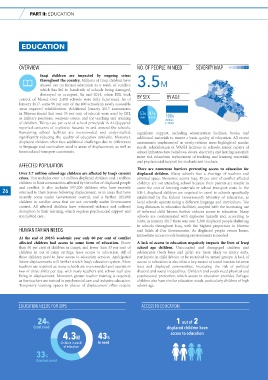
          At the end of 2016’s academic year only 60 per cent of conflict
          affected  children had  access  to  some  form  of  education.  Fewer   A lack of access to education negatively impacts the lives of Iraqi
                                                     EDUCATION
          than 50 per cent of children in camps, and fewer than 33 per cent of   school age children.  Unoccupied  and  disengaged  children  and
          children in out-of-camp settings, have access to education. All of   adolescents (both boys and girls) are more likely to marry early,
          these children need to have access to education services. Anticipated   participate in child labour, or be recruited by armed groups. A lack of
          future displacements will further stretch Iraq’s education system. More   access to education is also often a key source of social tension between
          teachers are required as many schools are overcrowded and operate in   host and displaced communities, increasing the risk of political
          two or three shifts per day, with many teachers and school staff also   discord and social inequalities. Children and youth need physical and
          living in displacement. Moreover, greater teacher training is required,   psychosocial protection, which access to education provides. Refugee
          as few teachers are trained in psychosocial care and inclusive education.   children also have similar education needs, particularly children of high
          Temporary learning spaces in places of displacement often require   school age.


         EDUCATION NEEDS FOR IDPS                               ACCESS TO EDUCATION


                                                                               1 out of 2
                  24%
                Great need                                                 displaced children have

                                                                             access to education

                             4.3M            43%
                            Children in need   In need
                             of education
                 33%
                 Greatest need

