


Page 22 - 2017_HNO_IRQ_web_Neat
P. 22
PART II: SHeLTeR AND NON-FOOD ITeMS


           SHELTER AND NON-FOOD ITEMS


          OVERVIEW                                            NO. OF PEOPLE IN NEED     SEVERITY MAP   -      +
                   The requirement for new and upgraded shelter
                   interventions has increased during 2016 and is
                   expected to continue into 2017. Newly-displaced   3.9M
                   people require tents and shelter kits, while shelters
          for the long-term displaced need to be repaired and maintained  BY SEX  BY AGE
          to an acceptable standard. Neglected housing needs to be
          renovated in return areas as a foundation for recovery for those
          able to return home in 2017. The extreme weather conditions   48% 52%
          in  winter and  summer  amplify  the need for non-food items   male  female  47% 47% 6%
                                                                           children adult elderly
          and shelter for all people in need throughout Iraq. During       (<18 yrs) (18-59) (>59)
          the winter months, adequate shelter, supported by critical
          household items can be life-saving. Sufficient quality mattresses
          and blankets must be supplemented with the means to heat   the 300,000 people in protracted displacement across Iraq, 82
          shelters and cook hot food. The lack of kerosene in the last part   per cent of whom are still in tents, to ensure a relative degree
          of 2016 has severely affected displaced people and vulnerable   of dignity and avoid negative consequences due to poor shelter
          residents in newly-retaken areas.  People displaced by the   conditions.
          ongoing military operations in Mosul and Hawiga will require
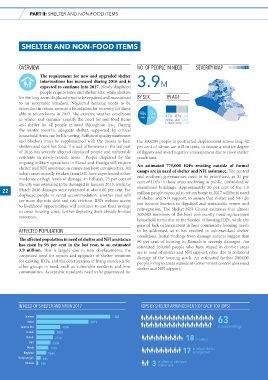
          shelter and NFI assistance in camps and host communities. All   An estimated 775,000 IDPs residing outside of formal
          urban areas recently retaken from ISIL have experienced either   camps are in need of shelter and NFI assistance. The central
          moderate or high levels of damage. In Fallujah, 75 per cent of   and southern governorates need to be prioritized, as 31 per
          the city was estimated to be damaged in January 2015, while by   cent of IDPs in these areas are living in public, unfinished or
                                                              abandoned buildings. Approximately 50 per cent of the 1.9
  22      March 2016 damages were estimated at about 80 per cent. For   million people expected to return home in 2017 will be in need
          displaced people in rental accommodation, another year will
          see more slip into debt and risk eviction. IDPs without access   of shelter and NFI support, to ensure that shelter and NFI do
          to livelihood opportunities will continue to use their savings   not become barriers to dignified and sustainable return and
          to cover housing costs, further depleting their already limited   reintegration. The Shelter-NFI Cluster  estimates  that almost
          resources.                                          300,000 members of the host community need replacement
                                                              household items due to the burden of hosting IDPs, while the
                                                              general lack of investment in host community housing needs
          AFFECTED POPULATION                                 to be addressed, as it has resulted in sub-standard shelter
                                                              conditions. Initial findings from damage surveys suggest that
          The affected population in need of shelter and NFI assistance   80  per  cent  of  housing in  Ramadi  is  severely  damaged.  An
          has risen by 95 per cent in the last year, to an estimated   estimated 560,000 people who have stayed in conflict areas
                                                     SHELTER & NFI
          3.9 million.  This is largely due to new displacements, the   are in need of shelter and NFI support, often due to collateral
          continued need for repairs and upgrades of shelter solutions   damage of the housing stock. An estimated further 200,000
          for existing IDPs, and the deterioration of living standards for   people living in areas outside of Government control also need
          other groups in need, such as vulnerable residents and host   shelter and NFI support.
          communities. Acceptable standards need to be guaranteed for


         IN NEED OF SHELTER AND NFI IN 2017                     IDPS BY SHELTER ARRANGEMENT (OF EACH 100 IDPS)

            Ninewa                                 1.3M                                           63
             Anbar                       887k
          Salah al-Din       404k                                                                 in private settings
             Kirkuk       302k
             Dahuk       275k                                                       18  in camps
              Erbil     233k
             Diyala    197k                                                            in critical shelter
            Baghdad   166k                                                        17 arrangement
         Sulaymaniyah  66k
            Kerbala  26k                                             3  in others or unknown
                                                                       shelter type

