


Page 20 - 2017_HNO_IRQ_web_Neat
P. 20
PART II: fOOd sECURITy


           FOOD SECURITY


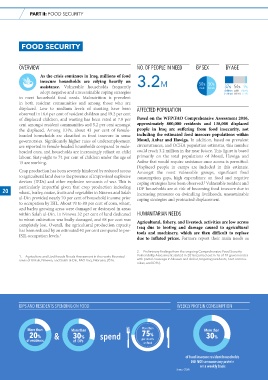
          OVERVIEW                                            NO. OF PEOPLE IN NEED     BY SEX       BY AGE
                   As the crisis continues in Iraq, millions of food
                   insecure households are relying heavily on
                   assistance. Vulnerable households frequently   3.2M                   50% 50%     37% 54% 9%
                                                                                             female
                                                                                          male
                   adopt negative and unsustainable coping strategies                                children adult elderly
                                                                                                     (<18 yrs) (18-59) (>59)
          to meet household food needs. Malnutrition is prevalent
          in  both resident communities  and among  those  who  are
          displaced. Low to medium levels of stunting have been   AFFECTED POPULATION
          observed in 16.6 per cent of resident children and 19.2 per cent
          of displaced children, and wasting has been rated at 7.8 per   Based on the WFP/FAO Comprehensive Assessment 2016,
          cent amongst resident communities and 5.2 per cent amongst   approximately 800,000 residents and 138,000 displaced
          the displaced. Among IDPs, about 43  per cent of female-  people in Iraq are suffering from food insecurity, not
          headed households are classified as food insecure in some   including the estimated food insecure populations within
          governorates. Significantly higher rates of underemployment   Mosul, Anbar and Hawiga. In addition, based on prevalent
          are reported in female-headed households compared to male-  circumstances, and OCHA population estimates, this number
          headed ones, and households are increasingly reliant on child   could reach 3.2 million in the near future. This figure is based
          labour. Sixty-eight to 74 per cent of children under the age of   primarily on the total populations of Mosul, Hawiga and
          15 are working.                                     Anbar that would require assistance once access is permitted.
                                                              Displaced  people  in  camps  are  included  in  this  estimate.
          Crop production has been severely hindered by reduced access   Amongst  the most  vulnerable  groups, significant  food
          to agricultural land due to the presence of improvised explosive   consumption gaps, high expenditure on food and negative
          devices (IEDs) and other explosive remnants of war. This is   coping strategies have been observed.  Vulnerable resident and
                                                                                            2
          particularly impactful given that crop production including   IDP households are at risk of becoming food insecure due to
  20      wheat, barley, maize, fruits and vegetables in Ninewa and Salah   increasing pressures on dwindling livelihoods, unsustainable
          al-Din provided nearly 70 per cent of household income prior   coping strategies and protracted displacement.
          to occupation by ISIL. About 70 to 80 per cent of corn, wheat,
          and barley growing areas were damaged or destroyed in areas
          within Salah al-Din. In Ninewa 32 per cent of land dedicated   HUMANITARIAN NEEDS
          to wheat cultivation was badly damaged, and 68 per cent was   Agricultural, fishery, and livestock activities are low across
          completely lost. Overall, the agricultural production capacity   Iraq due to looting and damage caused to agricultural
          has been reduced by an estimated 40 per cent compared to pre-  tools and machinery, which are then difficult to replace
          ISIL occupation levels. 1
                                                              due to inflated prices.  Farmers report their main needs as
                                                      FOOD
                                                              2.   Preliminary findings from the ongoing Comprehensive Food Security
          1.   Agriculture and Livelihoods Needs Assessment in the newly liberated   Vulnerability Assessment started in 2016 (carried out in 16 of 18 governorates
                                                              with partial coverage in Ninewa and Anbar, targeting residents, host commu-
          areas of Kirkuk, Ninewa, and Salah al-Din, FAO Iraq, February 2016.
                                                              nities, and IDPs).


         IDPS AND RESIDENTS SPENDING ON FOOD                                    WEEKLY PROTEIN CONSUMPTION


                                                                More than
             More than           More than                                                  More than
              20%        &       30%         spend              75%                          30%
             of residents         of IDPs                       per month
                                                                  on food

                                                                                   of food insecure resident households
                                                                                      DID NOT consume any protein
                                                                                           on a weekly basis
                                                                               Source: CFSVA

