


Page 16 - 2017_HNO_IRQ_web_Neat
P. 16
PART II: HEALTH


           HEALTH


          OVERVIEW                                            NO. OF PEOPLE IN NEED     SEVERITY MAP   -      +
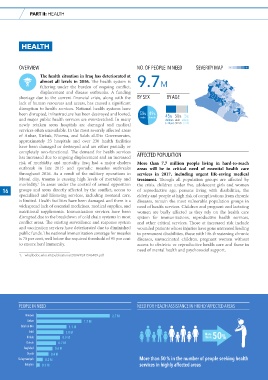
                   The health situation in Iraq has deteriorated at
                   almost all levels in 2016.  The health system is
                   faltering under the burden of ongoing conflict,   9.7M
                   displacement and disease outbreaks. A funding
          shortage due to the current financial crisis, along with the  BY SEX  BY AGE
          lack of human resources and access, has caused a significant
          disruption to health services.  National health systems have
          been disrupted, infrastructure has been destroyed and looted,   50% 49%  45% 50% 5%
          and major public health services are overstretched. In many   male  female  children adult elderly
          newly retaken areas hospitals are damaged and medical            (<18 yrs) (18-59) (>59)
          services often unavailable. In the most severely affected areas
          of Anbar, Kirkuk, Ninewa, and Salah al-Din Governorates,
          approximately 23 hospitals and over 230 health facilities
          have been damaged or destroyed and are either partially or
          completely non-functional. The demand for health services
          has increased due to ongoing displacement and an increased   AFFECTED POPULATION
          risk of morbidity and mortality. Iraq had a major cholera   More than 7.7 million people living in hard-to-reach
          outbreak in late 2015 and sporadic measles outbreaks   areas will be in critical need of essential health care
          throughout 2016. As a result of the military operations in   services in 2017, including urgent life-saving medical
          Mosul city, trauma is causing high levels of mortality and   treatment.  Though all population groups are affected by
          morbidity.  In areas under the control of armed opposition   the  crisis, children  under  five,  adolescent  girls  and  women
                  1
  16      groups and areas directly affected by the conflict, access to   of reproductive age, persons living with disabilities, the
          specialized and lifesaving services, including neonatal care,   elderly and people at high risk of complications from chronic
          is limited. Health facilities have been damaged and there is a   diseases,  remain  the  most  vulnerable  population  groups  in
          widespread lack of essential medicines, medical supplies, and   need of health services. Children and pregnant and lactating
          nutritional supplements. Immunization services have been   women are badly affected as they rely on the health care
          disrupted due to the breakdown of cold chain systems in most   system for immunizations, reproductive health services,
          conflict areas. The existing surveillance and response system   and other critical services. Those at increased risk include
          and vaccination services have deteriorated due to diminished   wounded patients whose injuries have gone untreated leading
          public funds. The national immunization coverage for measles   to permanent disabilities, those with life-threatening chronic
          is 75 per cent, well below the required threshold of 95 per cent   diseases, unvaccinated children, pregnant women without
          to ensure herd immunity.                            access to obstetric or reproductive health care and those in
                                                     HEALTH
                                                              need of mental health and psychosocial support.
          1.  whqlibdoc.who.int/publications/2004/9241546409.pdf


         PEOPLE IN NEED                                       NEED FOR HEALTH ASSISTANCE IN HIGHLY AFFECTED AREAS

            Ninewa                                 2.7 M
             Anbar                    1.7 M
          Salah al-Din          1.1 M
              Erbil           1.0 M                                                         More
             Kirkuk          0.9 M                                                          than  50%
             Dahuk         0.7 M
            Baghdad      0.6 M
             Diyala     0.4 M
         Sulaymaniyah  0.2 M                                   More than 50 % in the number of people seeking health
            Babylon  0.1 M                                     services in highly affected areas

