


Page 14 - 2017_HNO_IRQ_web_Neat
P. 14
PART II: PROTECTION


           PROTECTION


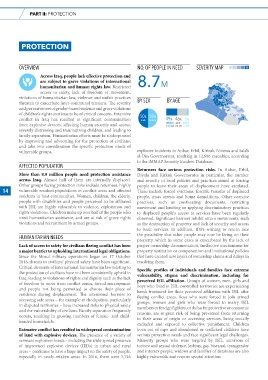
          OVERVIEW                                            NO. OF PEOPLE IN NEED     SEVERITY MAP   -      +
                   Across Iraq, people lack effective protection and
                   are subject to grave violations of international
                   humanitarian and human rights law. Restricted   8.7M
                   access to safety, lack of freedom of movement,
          violations of humanitarian law, violence and unfair practices
          threaten to exacerbate inter-communal tensions. The severity   BY SEX  BY AGE
          and pervasiveness of gender-based violence and grave violations
          of children’s rights continue to be of critical concern. Extensive
          conflict in Iraq has resulted in significant contamination   50% 50%  49% 46% 5%
                                                                male
                                                                   female
          from explosive devices, affecting human security and access,     children adult elderly
                                                                           (<18 yrs) (18-59) (>59)
          severely distressing and traumatizing children, and leading to
          family separation. Humanitarian efforts must be underpinned
          by improving and advocating for the protection of civilians,
          and take into consideration the specific protection needs of
          vulnerable groups.                                  explosive incidents in Anbar, Erbil, Kirkuk, Ninewa and Salah
                                                              al-Din Governorates, resulting in 12,686 casualties, according
                                                              to the iMMAP Security Incident Database.
          AFFECTED POPULATION
                                                              Returnees face serious protection risks.  In Anbar, Erbil,
          More than 8.9 million people need protection assistance   Diyala and Kirkuk Governorates in particular, the number
          across Iraq.  Almost half of them are internally displaced.   and severity of local policies and practices aimed at forcing
          Other groups facing protection risks include returnees, highly   people to leave their areas of displacement have escalated.
  14      vulnerable resident populations in conflict areas and affected   These include forced evictions, forcible transfer of displaced
          residents in host communities. Women, children, the elderly,   people, mass arrests and home demolitions. Other coercive
          people with disabilities and people perceived to be affiliated   practices, such as confiscating documents, restricting
          with ISIL are highly vulnerable to violence, exploitation and   movement and limiting or applying discriminatory practices
          rights violations. Children make up over half of the people who   to displaced people's access to services have been regularly
          need humanitarian assistance, and are at risk of grave rights   observed. Significant barriers inhibit return movements, such
          violations and recruitment by armed groups.         as the destruction of property and lack of security and access
                                                              to  basic  services.  In  addition,  IDPs  wishing  to  return  face
                                                              the possibility that other people may now be living on their
          HUMANITARIAN NEEDS
                                                              property, which in  some cases is  exacerbated  by the  lack of
          Lack of access to safety for civilians fleeing conflict has been   proper ownership documentation, ineffective mechanisms for                                     PROTECTION
          a major barrier to upholding international legal obligations.   property restitution or compensation and institutional policies
          Since the Mosul military operations began on 17  October   that have created new layers of ownership claims and delays in
          2016, threats to civilians’ physical safety have been significant.   resolving them.
          Critical elements of international humanitarian law relating to   Specific profiles of individuals and families face extreme
          the protection of civilians have not been consistently upheld in   vulnerability,  stigma  and  discrimination,  including  for
          Iraq, leading to violations of rights and dignity such as the lack   perceived ISIL affiliation. Groups of women, men, girls and
          of freedom to move from conflict zones, forced encampment   boys who lived in ISIL-controlled territories are experiencing
          and people not being permitted to choose their place of   harsh treatment for their perceived affiliation with ISIL after
          residence during displacement. The intentional barriers to   fleeing conflict areas. Boys who were forced to join armed
          accessing safe areas – for example at checkpoints, particularly   groups, women and girls who were forced to marry ISIL
          in disputed territories – have increased risks to physical safety   members or foreign fighters, or did so for protective or economic   BASIC NEEDS       INTIMATE PARTNER VIOLENCE          CHILDREN
          and the vulnerability of civilians. Family separation frequently   reasons, are at great risk of being prevented from returning
          occurs, resulting in growing numbers of female- and child-  to their areas of origin or accessing services, being socially                                                                              1 out of 2
          headed households.                                                                                                          28% of IDPs and returnees
                                                              excluded and exposed to collective punishment. Children             are women and girls of reproductive age                                     displaced is a child
          Extensive conflict has resulted in widespread contamination   born out of rape and abandoned or trafficked children have
          of land with explosive devices. The presence of a variety of   serious protection needs and face significant legal challenges.                                          97%
          remnant explosive threats – including the wide-spread presence   Minority groups who were targeted by ISIL, survivors of
          of improvised explosive devices (IEDs) in urban and rural   torture and sexual violence, lesbian, gay, bisexual, transgender
          areas – continues to have a huge impact on the safety of people,   and intersex people, widows and families of detainees are also
          especially in newly-retaken areas. In 2016, there were 5,746   highly vulnerable and require special attention.                                              of survivors who report incidents of
                                                                                                                                                                        gender-based violence are female
                                                                                                                                Source: IOM DTM July-Sept 2016     Source: (GBVIMS 2016)

