


Page 18 - 2017_HNO_IRQ_web_Neat
P. 18
PART II: WATeR, SANITATION & HyGIeNe


           WATER, SANITATION & HYGIENE


          OVERVIEW                                            NO. OF PEOPLE IN NEED     SEVERITY MAP   -      +
                   Lack of sustained, equitable access to safe water
                   and sanitation facilities and critical hygiene
                   items is negatively impacting public health   6.3M
                   and the dignity of people across Iraq.  In 2011,
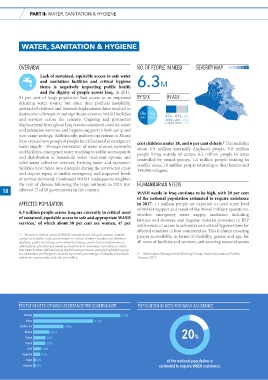
          91  per  cent of  Iraq’s  population had  access  to an  improved  BY SEX  BY AGE
          drinking water source, but since then political instability,
          protracted violence and internal displacement have resulted in
          destruction, disruption and significant stress on WASH facilities   50% 50%
          and services across the country. Ongoing and protracted   male  female  47% 47% 6%
                                                                           children adult elderly
          displacement throughout Iraq creates continued need for water    (<18 yrs) (18-59) (>59)
          and sanitation services, and hygiene support in both camp and
          non-camp settings. Additionally, military operations in Mosul
          have created new groups of people in critical need of emergency   cent children under 18, and 6 per cent elderly.  This includes
                                                                                                    2
          water supply – through restoration of water sources, networks   about 1.9 million internally displaced people, 0.8  million
          and facilities, emergency water trucking to public access points   people living outside of camps, 0.3 million people in areas
          and  distribution  of  household  water  treatment  options  and   controlled by armed groups, 1.4 million people residing in
          solid waste collection services. Existing water and sanitation   conflict areas, 1.6 million people returning to their homes and
          facilities have fallen into disrepair during the protracted crisis   198,000 refugees.
          and require repair to enable emergency, and improved levels
          of service delivered. Continued WASH inadequacies heighten
          the risk of cholera following the large outbreak in 2015 that   HUMANITARIAN NEEDS
  18      affected 17 of 18 governorates in the country.      WASH needs in Iraq continue to be high, with 20 per cent
                                                              of the national population estimated to require assistance
          AFFECTED POPULATION                                 in 2017. 1.4 million people are expected to need some level
                                                              of WASH support as a result of the Mosul military operations,
          6.3 million people across Iraq are currently in critical need   whether emergency water supply, sanitation including
          of sustained, equitable access to safe and appropriate WASH   latrines and showers, and hygiene material provision in IDP
          services,  of which about 50 per cent are women, 47 per   settlements, or access to safe water and critical hygiene items for
                 1
                                                              affected residents in host communities. This includes ensuring
          1.  People in critical need of WASH include those living in camps, outside   proper accessibility, in terms of disability, gender and age, for
          camps and within host communities in critical shelter conditions (collective
          shelters, public buildings, unfinished buildings, and informal settlements),   all users of facilities and services, and assuring seasonal access
                                                    WASH
          affected people who are newly accessible and returnees. Criticality of need
          has been further defined using the following criteria: people highlighting wa-
          ter, sanitation and hygiene as primary need, percentage of displaced people   2.  Information Management Working Group, Iraq Humanitarian Profile,
          within the community and risk of conflict.          January 2017.


         PEOPLE IN NEED OF WASH ASSISTANCE PER GOVERNORATE    POPULATION IN NEED FOR WASH ASSISTANCE

            Ninewa                                     2.3M
            Anbar                          1.6M
          Salah-al-Din        799k
            Kirkuk     421k
            Dahuk     321k                                                        20%
            Diyala    313k
             Erbil  199k
           Baghdad  177k
             Najaf  60k                                                    of the national population is
           Babylon  47k                                                 estimated to require WASH assistance.

