


Page 24 - 2017_HNO_IRQ_web_Neat
P. 24
PART II: CAMP COORdINATION ANd CAMP MANAgEMENT


           CAMP COORDINATION AND CAMP MANAGEMENT


          OVERVIEW                                            NO. OF PEOPLE IN NEED     SEVERITY MAP   -      +
                   Camp  coordination  and  camp  management
                   systems are required to ensure equitable access
                   to services and protection for displaced persons   1.3M
                   in formal and informal settlements. Settlements
          without coordination and management systems do not  BY SEX       BY AGE
          meet standards and are not maintained properly, leading to
          inadequate aid provision for vulnerable people. The lack of core
          services contributes to serious public health risks, preventable   48% 52%
          deaths, and increased risks of gender-based violence for   male  female  47% 47% 6%
                                                                           children adult elderly
          women and girls both in formal and informal settlements.         (<18 yrs) (18-59) (>59)
          Information dissemination and the  coordination of  service
          provision in camp settings are required to allow humanitarian
          partners to better coordinate assistance, support informed   governorate, district and site level. Anbar, Baghdad, Diyala,
          return intentions and strengthen accountability to affected   Hamdaniya, Kirkuk, Ninewa, and Salah al-Din Governorates
          populations.
                                                              are  the  highest  priorities  for  the  sector. There  is  a  need  to
                                                              identify and rectify threats to health and safety including man-
          AFFECTED POPULATION                                 made hazards and damage caused by weather conditions and
                                                              over-use of equipment, and to ensure regular maintenance and
          Over 2.7 million people in formal and informal settlements   solid waste removal, reducing the physical and public health
          need  camp coordination and camp management  services,   risks  in  and  around  settlement  sites.  Communication  with
          with women accounting for more than 50 per cent of the   communities and access to information on returns are critical.
  24      displaced.  Vulnerable  groups like women, girls, people   There is a lack of service mapping for informal sites, resulting
          with disabilities and the elderly are at risk of higher rates of   in duplication or gaps in service provision, and an inadequate
          discrimination and exclusion during displacement, as their   humanitarian response for people in need. Vulnerable people
          privacy and safety are most affected by inadequate or absent   in informal sites lack access to information about their rights
          camp  management systems and reduced  or un-prioritized   and available services.
          service provision.
                                                              Improved planning, construction and multi-service
                                                              mapping in formal sites are required to maximize resources
          HUMANITARIAN NEEDS                                  and services, and to reduce crime and protection risks,
          Strengthening camp management structures across Iraq is   particularly gender-based violence and sexual exploitation
          a key need. The capacity for camp management and effective   and abuse. Displacement is expected to continue to increase
                                                     CCCM
          coordination of different services and needs in a prioritized   into 2017, and the subsequent establishment of new formal
          manner continues to be a challenge in the majority of   settlements  will further  increase  camp management needs.
          formal  settlements.  Stronger  levels  of  coordination  and  the   Without planning, sites will later require costly reconstruction,
          implementation of impartial service provision are needed at   redesign  or  relocation  due  to  poor  site  preparation  and  lay-


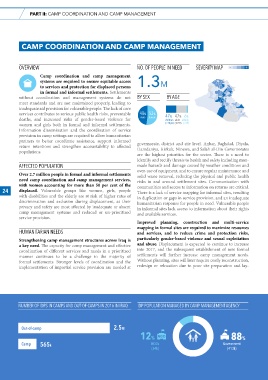
         NUMBER OF IDPS IN CAMPS AND OUT-OF-CAMPS IN 2016 IN IRAQ  IDP POPULATION MANAGED BY CAMP MANAGEMENT AGENCY


           Out-of-camp                              2.5M

                                                               12%                                      88%
           Camp    565k                                             NGOs                            Government
                                                                    (54k)                             (413k)

