


Page 27 - 2017_HNO_IRQ_web_Neat
P. 27
PART II: EMERgENCy LIVELIHOOds


           EMERGENCY LIVELIHOODS


          OVERVIEW                                            NO. OF PEOPLE IN NEED     SEVERITY MAP   -      +
                  The number of people currently considered to be
                  in need of emergency livelihoods assistance has
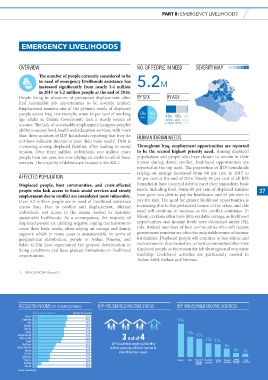
                  increased significantly from nearly 3.4 million   5.2M
                  in 2015 to 5.2 million people at the end of 2016.
          People living in situations of protracted displacement often  BY SEX  BY AGE
          find sustainable job opportunities to be severely limited.
          Employment remains one of the primary needs of displaced
          people across Iraq. For example, some 46 per cent of working   50% 50%
          age  adults  in  Dahuk  Governorate  lack  a  steady  source  of   male  female  46% 48% 6%
                                                                           children adult elderly
          income. The lack of sustainable employment hampers people’s      (<18 yrs) (18-59) (>59)
          ability to access food, health and education services, with more
          than three quarters of IDP households reporting that they do   HUMANITARIAN NEEDS
          not have sufficient income to meet their basic needs . Debt is
                                                    1
          increasing among displaced families, often leading to social   Throughout Iraq, employment opportunities are reported
          tension. Over three million individuals, one million more   to be the second highest priority need.  Among displaced
          people than last year, are now relying on credit to afford basic   populations and people who have chosen to remain in their
          services. The majority of debtors are located in the KR-I.  homes during direct conflict, livelihood opportunities are
                                                              reported as the top need. The proportion of IDP households
                                                              relying on savings decreased from 64 per cent in 2015 to
          AFFECTED POPULATION                                 35 per cent at the end of 2016. Nearly 85 per cent of all IDP
          Displaced  people,  host  communities,  and  crisis-affected   households have incurred debt to meet their immediate basic
          people who lack access to basic social services and steady   needs, including food. Some 68 per cent of displaced families   27
          employment due to conflict are considered most vulnerable.   have gone into debt to pay for healthcare, and 53 per cent to
          Over 5.2 million people are in need of livelihood assistance   pay for rent. The need for greater livelihood opportunities is
          across Iraq. Due to conflict and displacement, affected   increasing due to the protracted nature of the crisis, and this
          individuals lost access to the means needed to maintain   need will continue to increase as the conflict continues. In
          sustainable livelihoods. As a consequence, the majority of   Mosul, civilians often have little available savings, as livelihood
          displaced people are utilizing negative coping mechanisms to   opportunities and income levels were decimated under ISIL
          cover their basic needs, often relying on savings and family   rule. Retired members of host communities who still receive
          support, which in many cases is unsustainable. In terms of   government pensions are often the only stable source of income
          geographical  distribution,  people in  Anbar, Ninewa,  and   for families. Displaced people will continue to face ethnic and
          Salah al-Din have experienced the greatest deterioration in   socioeconomic discrimination, as host communities often view
                               EMERGENCY LIVELIHOODS AND SOCIAL COHESION
          living conditions and have greatest limitations on livelihood   displaced people as the reason for job shortages and economic
          opportunities.                                      hardship. Livelihood activities are particularly needed in
                                                              Anbar, Erbil, Kirkuk and Ninewa.


          1.   REACH MCNA Round 3.


         ACCESS TO INCOME (18-59 YEAR-OLD MALE)  IDP HOUSEHOLD INCOME STATUS    IDP HOUSEHOLD INCOME SOURCES
                NO access to income   Access to income
            Dahuk  59%                 41%
           Baghdad  59%                41%                                      31%
             Erbil  56%                44%
            Ninewa  56%                44%
            Missan  53%                47%
            Diyala  53%                47%
         Sulaymaniyah  53%             47%             3 out of 4                   19%  17%
          Salah al- Din-Din  50%       50%
             Najaf  48%                52%                                                  13%  12%
           Muthana  39%                61%         IDP households reporting that they
         Mejar Al-Kabir  37%           63%        did not generate sufficient income to              8%
            Wassit  33%                67%            meet their basic needs                             4%  3%
            Thi-Qar    29%             71%
           Qadissiya  29%              71%
                                                                                                         Using
           Babylon  27%                73%                                      Savings   Debt  Support of  Charitable   Selling  Reduced   previous   Sold
            Kerbala  15%               85%                                              friends/  donations  assets  spending  income  assistance
                                                                                        relatives
            Basrah  8%                 92%
         Source: Government

