


Page 8 - Earthworks Full Line Catalog 2016
P. 8
Impulse Response & Frequency Response

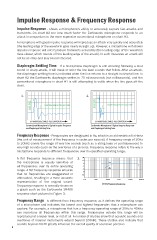
Impulse Response - shows a microphone’s ability to accurately capture fast attacks and

transients. On chart #2 see how much faster the Earthworks microphone responds to an
attack in comparison to the more expensive conventional microphone on chart #1.
A microphone with good impulse response will reproduce an attack very quickly and accurately
(the leading edge of the waveform goes nearly straight up). However, a microphone with slower
impulse response will not reproduce transients accurately (the leading edge of the waveform
rises slower, which rounds off the leading edge of the attack). In such instances an attack will
not be as crisp and may sound smeared.

Diaphragm Settling Time - If a microphone diaphragm is still vibrating following a loud

sound or sharp attack, it will mask or color the low level sounds that follow. After an attack,
the diaphragm settling time is indicated when the line returns to a straight horizontal line. In
chart #2 the Earthworks diaphragm settles in 70 microseconds (not milliseconds), and the
conventional microphone in chart #1 is still attempting to settle when the line goes off the
chart.

   1. 2.

Conventional Microphone's Typical Impulse Response      Earthworks Microphone's Typical Impulse Response
and Diaphragm Settling Time                             and Diaphragm Settling Time

Frequency Response - Frequencies are designated in Hz, which is an abbreviation for Hertz

(the unit of measurement of the frequency in cycles per second). A frequency range of 20Hz
to 20kHz covers the range of very low sounds (such as a string bass or contrabassoon) to
very high sounds (such as the overtones of a piccolo). Frequency response refers to the way a
microphone responds to different frequencies over its specified operating range.

A flat frequency response means that                3.
the microphone is equally sensitive at
all frequencies over its entire operating               SR40V Frequency Response
range. A flat frequency response ensures
that no frequencies are exaggerated or
attenuated, resulting in a more accurate
representation of the original sound.
Frequency response is normally shown on
a graph such as the Earthworks SR40V
response chart pictured in Figure 3.

   Frequency Range - is different from frequency response, as it defines the operating range

    of a microphone and indicates the lowest and highest frequencies that a microphone can
    capture. For example, a microphone that has a frequency operating range of 30Hz to 40kHz
    can reproduce all frequencies within this range. Frequencies outside this range will be
    reproduced at a lesser level, or not at all. A number of studies show that acoustic sounds and
    overtones of musical instruments extend beyond 100kHz. These studies also indicate that
    sounds beyond 20kHz greatly influence the overall quality of sound we perceive.

6

