


Page 9 - Earthworks Full Line Catalog 2016
P. 9
Polar Response & Rear Rejection

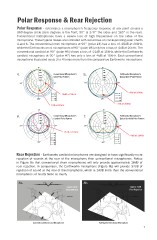
Polar Response - determines a microphone’s frequency response at any point around a

360-degree circle (zero degrees is the front, 90° & 270° the sides and 180° is the rear).
Conventional microphones have a severe loss of high frequencies on the sides of the
microphone. These typical losses are indicated with red arrows on corresponding polar charts
4 and 6. The conventional omni microphone at 90° (polar #4) has a loss of -18dB at 20kHz,
while the Earthworks omni microphones at 90° (polar #5) only has a loss of -4dB at 20kHz. The
conventional cardioid at 90° (polar #6) shows a loss of -21dB at 15kHz, while the Earthworks
cardioid microphone at 90° (polar #7) has only a loss of -4dB at 15kHz. Each conventional
microphone illustrated costs 3 to 4 times more than the comparative Earthworks microphone.

4.  Conventional Microphone's                            5.      Earthworks Microphone's
    Omni Polar Pattern                                           Typical Omni Polar Pattern

                  -18dB at 20kHz                               1K -4dB at 20kHz
    -7dB at 20kHz
                                                                  5K
                                                                  10K
                                                                  20K

                                                             -7dB at 20kHz

6.  Conventional Microphone's                            7.      Earthworks Microphone's
    Cardioid Polar Pattern                                       Typical Cardioid Polar Pattern

    -21dB at 15kHz                                           500
                                                             1K
                                                                                                -4dB at 15kHz

                                                             2K

                                                             4K

                                                             8K

                                                             15K

Rear Rejection - Earthworks cardioid microphones are designed to have significantly more

rejection of sounds at the rear of the microphone than conventional microphones. Notice
in Figure 8a that conventional drum microphones will only provide approximately 18dB of
rear rejection. In comparison, the Earthworks microphone (Figure 8b) will provide 32dB of
rejection of sound at the rear of the microphone, which is 14dB more than the conventional
microphone, or nearly twice as much.

8a. 8b.

                                         Approx 18dB                                            Approx 32dB
                                         Rear Rejection                                         Rear Rejection

    Conventional Directional Microphone                      Earthworks Directional Microphone

                                                                                                                7

