


Page 141 - 'Blast_Into_Math
P. 141
Blast into Math!                         Mathematical perspectives: all aour mase are melong to us


                                                                                                p
                     •  Hint for # 4: You have seen that every even perfect number is of the form 2 p−1 (2 − 1) for
                        a prime number  p  such that 2 − 1 is a Mersenne prime. What does this look like when
                                                   p
                        you write it in base 2? You may find #2 and # 3 helpful.
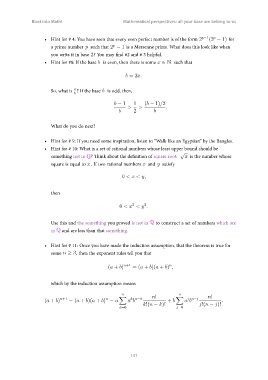
                     •  Hint for #8: If the base b  is even, then there is some x ∈ N  such that


                                                         b =2x.


                                  x
                        So, what is  ? If the base b  is odd, then,
                                  b
                                                    b − 1   1    (b − 1)/2
                                                          >    >           .
                                                      b     2        b


                        What do you do next?


                     •  Hint for # 9: If you need some inspiration, listen to “Walk like an Egyptian” by the Bangles.
                     •  Hint for # 10: What is a set of rational numbers whose least upper bound should be
                                                                                 √
                        something not in Q? Think about the definition of square root:   x  is the number whose
                        square is equal to x . If two rational numbers x  and  y  satisfy


                                                       0 <x<y,


                        then


                                                            2
                                                                 2
                                                      0 <x <y .

                        Use this and the something you proved is not in Q to construct a set of numbers which are
                        in Q and are less than that something.


                     •  Hint for # 11: Once you have made the induction assumption, that the theorem is true for
                        some n ≥ 3, then the exponent rules tell you that


                                                                            n
                                                 (a + b) n+1  =(a + b)(a + b) ,


                        which by the induction assumption means

                                                       n             n!         n            n!
                                                           k n−k
                                                n
                                                                                    j n−j
                     (a + b) n+1  =(a + b)(a + b) = a    a b              + b    a b             .
                                                                 k!(n − k)!               j!(n − j)!
                                                      k=0                      j=0


                                                           141

