


Page 138 - 'Blast_Into_Math
P. 138
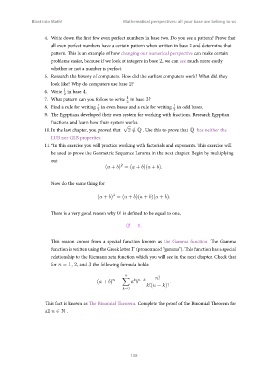
Blast into Math!                         Mathematical perspectives: all aour mase are melong to us


                     4.  Write down the first few even perfect numbers in base two. Do you see a pattern? Prove that
                        all even perfect numbers have a certain pattern when written in base 2 and determine that
                        pattern. This is an example of how changing our numerical perspective can make certain
                        problems easier, because if we look at integers in base 2, we can see much more easily
                        whether or not a number is perfect.
                     5.  Research the history of computers. How did the earliest computers work? What did they
                        look like? Why do computers use base 2?
                     6.  Write   in base 4.
                             1
                             2
                     7.  What pattern can you follow to write   in base 3?
                                                         1
                                                         2
                     8.  Find a rule for writing   in even bases and a rule for writing   in odd bases.
                                            1
                                                                              1
                                            2                                 2
                     9.  The Egyptians developed their own system for working with fractions. Research Egyptian
                        fractions and learn how their system works.
                                                        √
                     10. In the last chapter, you proved that   2 /∈ Q . Use this to prove that  Q  has neither the
                        LUB nor GLB properties.
                     11. *In this exercise you will practice working with factorials and exponents. This exercise will
                        be used to prove the Geometric Sequence Lemma in the next chapter. Begin by multiplying

                        out
                                                       2
                                                (a + b) =(a + b)(a + b).


                        Now do the same thing for


                                                   3
                                            (a + b) =(a + b)(a + b)(a + b).

                        There is a very good reason why 0! is defined to be equal to one,


                                                         0! =1.


                        This reason comes from a special function known as  the Gamma function. The Gamma
                        function is written using the Greek letter Γ (pronounced “gamma”). This function has a special
                        relationship to the Riemann zeta function which you will see in the next chapter. Check that
                        for n =1, 2, and 3 the following formula holds:


                                                         n            n!
                                                   n
                                                            k n−k
                                            (a + b) =     a b              .
                                                                  k!(n − k)!
                                                       k=0
                     This fact is known as The Binomial Theorem. Complete the proof of the Binomial Theorem for
                     all n ∈ N .


                                                           138

