


Page 143 - 'Blast_Into_Math
P. 143
Blast into Math!                         Mathematical perspectives: all aour mase are melong to us


                                                              1
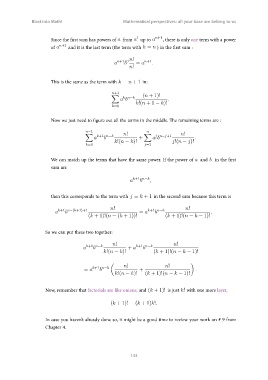
                        Since the first sum has powers of a  from a  up to a n+1 , there is only one term with a power
                        of a n+1  and it is the last term (the term with k = n ) in the first sum :


                                                          n!
                                                        b
                                                    a n+1 0  = a n+1 .
                                                          n!

                        This is the same as the term with k = n +1 in:

                                                   n+1
                                                       k n−k   (n +1)!
                                                      a b                   .
                                                             k!(n +1 − k)!
                                                   k=0

                        Now we just need to figure out all the terms in the middle. The remaining terms are :


                                       n−1                        n
                                           k+1 n−k     n!           j n−j+1    n!
                                           a   b               +     a b               .
                                                    k!(n − k)!                j!(n − j)!
                                       k=0                       j=1

                        We can match up the terms that have the same power. If the power of a  and b  in the first
                        sum are


                                                           a k+1 n−k ,
                                                               b

                        then this corresponds to the term with  j = k +1 in the second sum because this term is


                                                  n!                               n!
                          a k+1 n−(k+1)+1                      = a k+1 n−k                     .
                                                                      b
                              b
                                        (k +1)!(n − (k +1))!              (k +1)!(n − k − 1)!
                     So we can put these two together:


                                                   n!                         n!
                                                                 b
                                          b
                                      a k+1 n−k           + a k+1 n−k
                                               k!(n − k)!            (k +1)!(n − k − 1)!

                                                        n!                n!
                                             b
                                      = a k+1 n−k              +                        .
                                                    k!(n − k)!   (k +1)!(n − k − 1)!
                     Now, remember that factorials are like onions, and (k +1)! is just k! with one more layer,


                                                  (k +1)! =(k +1)k!.


                     In case you haven’t already done so, it might be a good time to review your work on # 9 from
                     Chapter 4.


                                                           143

