


Page 147 - 'Blast_Into_Math
P. 147
Blast into Math!                                 Analatic nummer theora: ants, ghosts and giants


               Another sequence of numbers is

                                                          1
                                                           ∞
                                                                 .
                                                          n
                                                             n=1

               In this example, the n  term is 1/n , so we could also write
                                   th
                                                                    1
                                                        ∞
                                                   {x n } n=1 ,  x n =  .
                                                                    n


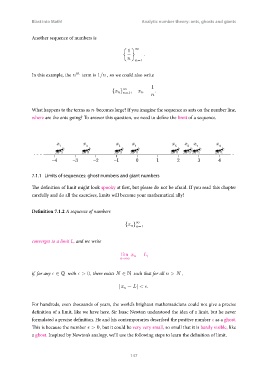
               What happens to the terms as n  becomes large? If you imagine the sequence as ants on the number line,
               where are the ants going? To answer this question, we need to define the limit of a sequence.


                          x           x              x      x                 x    x   x         x
                            1          2              3      4                 5    6   7         8


                        {4       {3       {2        {1       0         1        2        3        4


               7.1.1  Limits of sequences: ghost numbers and giant numbers

               The definition of limit might look spooky at first, but please do not be afraid. If you read this chapter
               carefully and do all the exercises, limits will become your mathematical ally!


               Definition 7.1.2 A sequence of numbers

                                                             ∞
                                                         {x n }
                                                             n=1

               converges to a limit L, and we write


                                                       lim x n = L,
                                                      n→∞


               if, for any  ∈ Q  with > 0, there exists N ∈ N  such that for all n> N ,


                                                      |x n − L| <.


               For hundreds, even thousands of years, the world’s brightest mathematicians could not give a precise

               definition of a limit, like we have here. Sir Isaac Newton understood the idea of a limit, but he never
               formulated a precise definition. He and his contemporaries described the positive number  as a ghost.
               This is because the number > 0, but it could be very very small, so small that it is barely visible, like
               a ghost. Inspired by Newton’s analogy, we’ll use the following steps to learn the definition of limit.


                                                           147

