


Page 182 - 'Blast_Into_Math
P. 182
Blast into Math!                                 Analatic nummer theora: ants, ghosts and giants


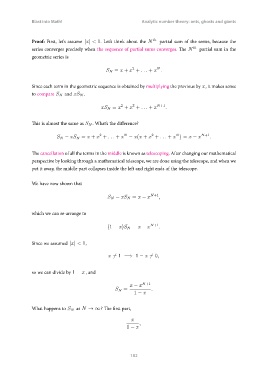
               Proof: First, let’s assume  |x| < 1. Let’s think about the  N th   partial sum of the series, because the
               series converges precisely when the sequence of partial sums converges. The N  th   partial sum in the
               geometric series is

                                                                       N
                                                            2
                                                S N = x + x + ... + x .

               Since each term in the geometric sequence is obtained by multiplying the previous by x, it makes sense
               to compare S N  and xS N .


                                                       2
                                                            3
                                              xS N = x + x + ... + x   N+1 .
               This is almost the same as S N . What’s the difference?


                                             2
                                                        N
                                                                               N
                                                                    2
                          S N − xS N = x + x + ... + x − x(x + x + ... + x )= x − x       N+1 .
               The cancellation of all the terms in the middle is known as telescoping. After changing our mathematical
               perspective by looking through a mathematical telescope, we are done using the telescope, and when we
               put it away, the middle part collapses inside the left and right ends of the telescope.


               We have now shown that


                                                 S N − xS N = x − x N+1 ,


               which we can re-arrange to


                                                 (1 − x)S N = x − x N+1 .


               Since we assumed  |x| < 1,


                                                 x =1 =⇒ 1 − x =0,


               so we can divide by 1 − x , and


                                                           x − x N+1
                                                    S N =           .
                                                             1 − x


               What happens to S N  as N →∞? The first part,


                                                           x
                                                               ,
                                                         1 − x


                                                           182

