


Page 199 - 'Blast_Into_Math
P. 199
Blast into Math!                                 Analatic nummer theora: ants, ghosts and giants


               Nonsense! The inequalities mean that 1 > 1 which is false. So, by contradiction we have proven that

               there is only one real number  y  such that

                                                          y
                                                         e = x,

               and

                                                       log(x)= y.


                                                                                                      ∞
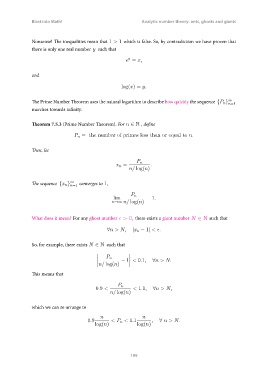
               The Prime Number Theorem uses the natural logarithm to describe how quickly the sequence {P n } n=1
               marches towards infinity.


               Theorem 7.5.3 (Prime Number Theorem). For n ∈ N , define

                                  P n =the number of primes less than or equalto n.


               Then, let

                                                              P n
                                                     x n =          .
                                                          n/ log(n)


                                ∞    converges to 1,
               The sequence  {x n } n=1

                                                           P n
                                                   lim            =1.
                                                   n→∞ n/ log(n)


               What does it mean? For any ghost number > 0, there exists a giant number N ∈ N  such that

                                                 ∀n> N,     |x n − 1| <.


               So, for example, there exists N ∈ N  such that


                                               P n
                                                       − 1 < 0.1,    ∀n> N.

                                             n/ log(n)

               This means that

                                                     P n
                                            0.9 <           < 1.1,   ∀n> N,
                                                  n/ log(n)

               which we can re-arrange to

                                              n                 n
                                        0.9       <P n < 1.1        ,   ∀ n> N.
                                           log(n)             log(n)


                                                           199

