


Page 197 - 'Blast_Into_Math
P. 197
Blast into Math!                                 Analatic nummer theora: ants, ghosts and giants


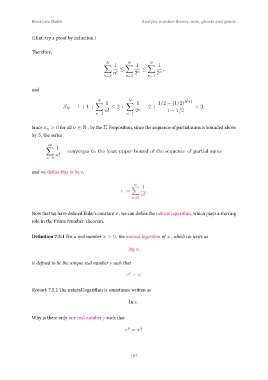
               (Hint: try a proof by induction.)


               Therefore,

                                                N         N         N
                                                    1        1         1

                                                      ≤         ≤        ,
                                                   n!        2 n       2 n
                                               n=2       n=2       n=1
               and

                                            N             N                        N+1
                                               1            1        1/2 − (1/2)
                             S N =1 +1 +          ≤ 2+          =2 +                    < 3.
                                                n!           2 n           1 − 1/2
                                            n=2          n=1
               Since x n > 0 for all n ∈ N , by the Σ Proposition, since the sequence of partial sums is bounded above
               by 3, the series


                      ∞
                          1

                               convergestothe least upper bound of thesequenceofpartial sums
                          n!
                      n=0
               and we define this to be e,


                                                            ∞
                                                               1
                                                       e :=       .
                                                                n!
                                                            n=0

               Now that we have defined Euler’s constant e , we can define the natural logarithm, which plays a starring
               role in the Prime Number Theorem.


               Definition 7.5.1 For a real number x> 0, the natural logarithm of x , which we write as


                                                          log x,


               is defined to be the unique real number y such that

                                                          y
                                                         e = x.

               Remark 7.5.2 The natural logarithm is sometimes written as


                                                          ln x.


               Why is there only one real number y such that

                                                          y
                                                         e = x?


                                                           197

