


Page 127 - [Uma_Sekaran]_Research_methods_for_business__a_sk(BookZZ.org)
P. 127
EXAMPLE OF LITERATURE REVIEW, THEORETICAL FRAMEWORK, HYPOTHESES 111

                               Exclusion from the networks where men informally interact with one another
                             (golf course, pubs, and so on) also precludes women from gaining access to cru-
                             cial information and resources vital for their advancement. For example, many of
                             the significant organizational changes and current events are discussed informally
                             among men outside the work setting. Women are generally unaware of the most
                             recent developments since they are not a part of the informal group that inter-
                             acts and exchanges information away from the workplace. This definitely is a
                             handicap. For example, knowledge of an impending vacancy for an executive
                             position enables one to strategize to occupy that position. One can become a
                             key contender by procuring critical information relevant to the position, get pre-
                             pared to present the appropriate credentials to the right people at the right time,
                             and thus pave the way for success. Thus, access to critical information is impor-
                             tant for the progress of all, including women. When women do not have the crit-
                             ical information that is shared in informal networks, their chances of
                             advancement to top positions also get severely restricted.
                               Gender-role stereotypes also hinder access to information. If women are not
                             considered to be decision makers and leaders, but are perceived merely as sup-
                             port personnel, they would not be apprised of critical information essential for
                             organizational advancement, since this would not be seen as relevant for them.
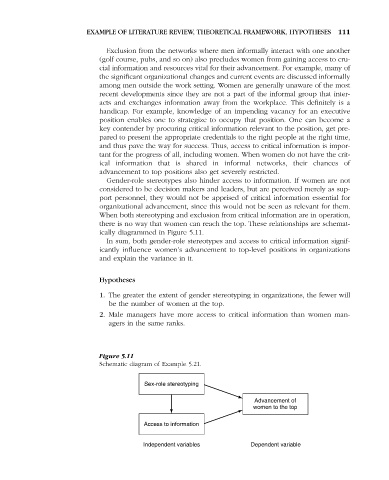
                             When both stereotyping and exclusion from critical information are in operation,
                             there is no way that women can reach the top. These relationships are schemat-
                             ically diagrammed in Figure 5.11.
                               In sum, both gender-role stereotypes and access to critical information signif-
                             icantly influence women’s advancement to top-level positions in organizations
                             and explain the variance in it.


                             Hypotheses

                             1. The greater the extent of gender stereotyping in organizations, the fewer will
                               be the number of women at the top.
                             2. Male managers have more access to critical information than women man-
                               agers in the same ranks.


                             Figure 5.11
                             Schematic diagram of Example 5.21.

                                         Sex-role stereotyping

                                                                        Advancement of
                                                                       women to the top

                                         Access to information


                                         Independent variables         Dependent variable

