


Page 134 - [Uma_Sekaran]_Research_methods_for_business__a_sk(BookZZ.org)
P. 134
118  THE RESEARCH PROCESS

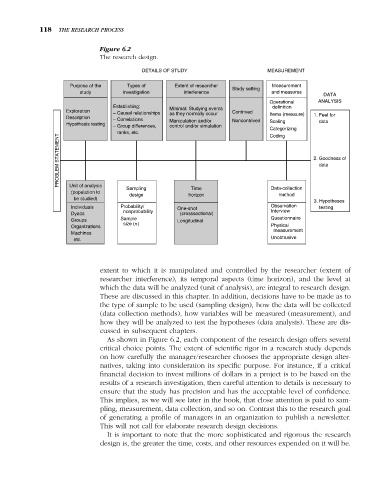
                             Figure 6.2
                             The research design.

                                        DETAILS OF STUDY                   MEASUREMENT
                    Purpose of the  Types of      Extent of researcher       Measurement
                                                                 Study setting
                       study       investigation    interference            and measures
                                                                                           DATA
                                                                            Operational  ANALYSIS
                                Establishing:   Minimal: Studying events      definition
                   Exploration                                   Contrived
                                – Causal relationships  as they normally occur  Items (measure)  1. Feel for
                   Description
                                – Correlations  Manipulation and/or  Noncontrived  Scaling      data
                   Hypothesis testing
                                – Group differences,  control and/or simulation
                                                                            Categorizing
                                   ranks, etc.                              Coding
                 PROBLEM STATEMENT                                                      2. Goodness of
                                                                                            data

                    Unit of analysis
                                    Sampling          Time                  Data-collection
                     (population to
                                     design          horizon                  method
                     be studied)
                                                                                        3. Hypotheses
                     Individuals  Probability/    One-shot                  Observation      testing
                                    nonprobability                          Interview
                     Dyads                          (crosssectional)
                     Groups       Sample          Longitudinal              Questionnaire
                                    size (n)
                     Organizations                                          Physical
                                                                              measurement
                     Machines
                                                                            Unobtrusive
                       etc.
                             extent to which it is manipulated and controlled by the researcher (extent of
                             researcher interference), its temporal aspects (time horizon), and the level at
                             which the data will be analyzed (unit of analysis), are integral to research design.
                             These are discussed in this chapter. In addition, decisions have to be made as to
                             the type of sample to be used (sampling design), how the data will be collected
                             (data collection methods), how variables will be measured (measurement), and
                             how they will be analyzed to test the hypotheses (data analysis). These are dis-
                             cussed in subsequent chapters.
                               As shown in Figure 6.2, each component of the research design offers several
                             critical choice points. The extent of scientific rigor in a research study depends
                             on how carefully the manager/researcher chooses the appropriate design alter-
                             natives, taking into consideration its specific purpose. For instance, if a critical
                             financial decision to invest millions of dollars in a project is to be based on the
                             results of a research investigation, then careful attention to details is necessary to
                             ensure that the study has precision and has the acceptable level of confidence.
                             This implies, as we will see later in the book, that close attention is paid to sam-
                             pling, measurement, data collection, and so on. Contrast this to the research goal
                             of generating a profile of managers in an organization to publish a newsletter.
                             This will not call for elaborate research design decisions.
                               It is important to note that the more sophisticated and rigorous the research
                             design is, the greater the time, costs, and other resources expended on it will be.

