


Page 224 - [Uma_Sekaran]_Research_methods_for_business__a_sk(BookZZ.org)
P. 224
208  MEASUREMENT: SCALING, RELIABILITY, VALIDITY

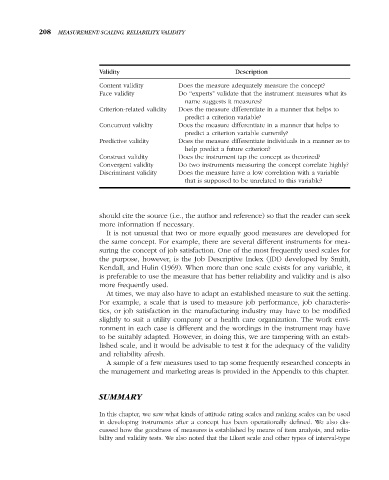
                             Table 9.1
                             Types of Validity
                             Validity                             Description
                             Content validity      Does the measure adequately measure the concept?
                             Face validity         Do ‘‘experts” validate that the instrument measures what its
                                                    name suggests it measures?
                             Criterion-related validity  Does the measure differentiate in a manner that helps to
                                                    predict a criterion variable?
                             Concurrent validity   Does the measure differentiate in a manner that helps to
                                                    predict a criterion variable currently?
                             Predictive validity   Does the measure differentiate individuals in a manner as to
                                                    help predict a future criterion?
                             Construct validity    Does the instrument tap the concept as theorized?
                             Convergent validity   Do two instruments measuring the concept correlate highly?
                             Discriminant validity  Does the measure have a low correlation with a variable
                                                    that is supposed to be unrelated to this variable?


                             should cite the source (i.e., the author and reference) so that the reader can seek
                             more information if necessary.
                               It is not unusual that two or more equally good measures are developed for
                             the same concept. For example, there are several different instruments for mea-
                             suring the concept of job satisfaction. One of the most frequently used scales for
                             the purpose, however, is the Job Descriptive Index (JDI) developed by Smith,
                             Kendall, and Hulin (1969). When more than one scale exists for any variable, it
                             is preferable to use the measure that has better reliability and validity and is also
                             more frequently used.
                               At times, we may also have to adapt an established measure to suit the setting.
                             For example, a scale that is used to measure job performance, job characteris-
                             tics, or job satisfaction in the manufacturing industry may have to be modified
                             slightly to suit a utility company or a health care organization. The work envi-
                             ronment in each case is different and the wordings in the instrument may have
                             to be suitably adapted. However, in doing this, we are tampering with an estab-
                             lished scale, and it would be advisable to test it for the adequacy of the validity
                             and reliability afresh.
                               A sample of a few measures used to tap some frequently researched concepts in
                             the management and marketing areas is provided in the Appendix to this chapter.


                             SUMMARY

                             In this chapter, we saw what kinds of attitude rating scales and ranking scales can be used
                             in developing instruments after a concept has been operationally defined. We also dis-
                             cussed how the goodness of measures is established by means of item analysis, and relia-
                             bility and validity tests. We also noted that the Likert scale and other types of interval-type

