


Page 220 - [Uma_Sekaran]_Research_methods_for_business__a_sk(BookZZ.org)
P. 220
204  MEASUREMENT: SCALING, RELIABILITY, VALIDITY

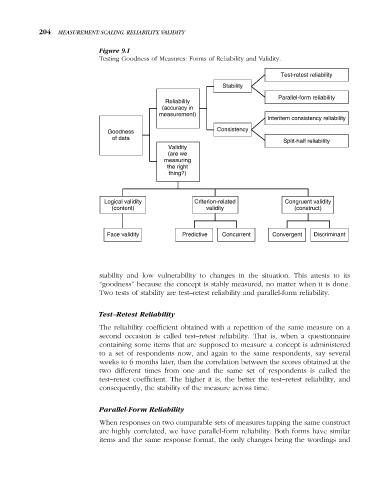
                             Figure 9.1
                             Testing Goodness of Measures: Forms of Reliability and Validity.

                                                                               Test-retest reliability
                                                               Stability
                                                                              Parallel-form reliability
                                               Reliability
                                              (accuracy in
                                             measurement)
                                                                           Interitem consistency reliability
                                                             Consistency
                               Goodness
                                of data
                                                                                Split-half reliability
                                                Validity
                                                (are we
                                               measuring
                                               the right
                                                thing?)


                              Logical validity         Criterion-related        Congruent validity
                                (content)                 validity                 (construct)


                               Face validity        Predictive  Concurrent   Convergent  Discriminant


                             stability and low vulnerability to changes in the situation. This attests to its
                             “goodness” because the concept is stably measured, no matter when it is done.
                             Two tests of stability are test–retest reliability and parallel-form reliability.


                             Test–Retest Reliability
                             The reliability coefficient obtained with a repetition of the same measure on a
                             second occasion is called test–retest reliability. That is, when a questionnaire
                             containing some items that are supposed to measure a concept is administered
                             to a set of respondents now, and again to the same respondents, say several
                             weeks to 6 months later, then the correlation between the scores obtained at the
                             two different times from one and the same set of respondents is called the
                             test–retest coefficient. The higher it is, the better the test–retest reliability, and
                             consequently, the stability of the measure across time.

                             Parallel-Form Reliability

                             When responses on two comparable sets of measures tapping the same construct
                             are highly correlated, we have parallel-form reliability. Both forms have similar
                             items and the same response format, the only changes being the wordings and

