


Page 215 - [Uma_Sekaran]_Research_methods_for_business__a_sk(BookZZ.org)
P. 215
RATING SCALES 199

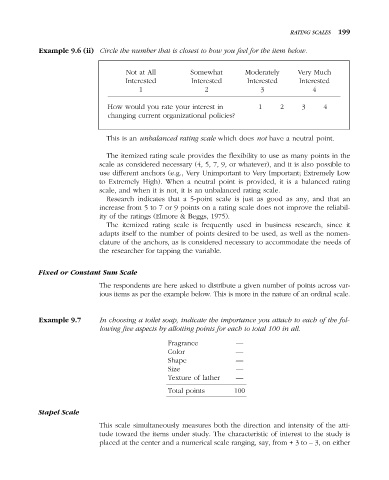
            Example 9.6 (ii) Circle the number that is closest to how you feel for the item below.


                                    Not at All        Somewhat       Moderately     Very Much
                                    Interested        Interested      Interested    Interested
                                        1                 2              3              4

                               How would you rate your interest in       1     2     3     4
                               changing current organizational policies?


                               This is an unbalanced rating scale which does not have a neutral point.
                               The itemized rating scale provides the flexibility to use as many points in the
                             scale as considered necessary (4, 5, 7, 9, or whatever), and it is also possible to
                             use different anchors (e.g., Very Unimportant to Very Important; Extremely Low
                             to Extremely High). When a neutral point is provided, it is a balanced rating
                             scale, and when it is not, it is an unbalanced rating scale.
                               Research indicates that a 5-point scale is just as good as any, and that an
                             increase from 5 to 7 or 9 points on a rating scale does not improve the reliabil-
                             ity of the ratings (Elmore & Beggs, 1975).
                               The itemized rating scale is frequently used in business research, since it
                             adapts itself to the number of points desired to be used, as well as the nomen-
                             clature of the anchors, as is considered necessary to accommodate the needs of
                             the researcher for tapping the variable.


            Fixed or Constant Sum Scale
                             The respondents are here asked to distribute a given number of points across var-
                             ious items as per the example below. This is more in the nature of an ordinal scale.


            Example 9.7      In choosing a toilet soap, indicate the importance you attach to each of the fol-
                             lowing five aspects by allotting points for each to total 100 in all.

                                                Fragrance          —
                                                Color              —
                                                Shape              —
                                                Size               —
                                                Texture of lather  —
                                                Total points      100


            Stapel Scale
                             This scale simultaneously measures both the direction and intensity of the atti-
                             tude toward the items under study. The characteristic of interest to the study is
                             placed at the center and a numerical scale ranging, say, from + 3 to – 3, on either

