


Page 218 - [Uma_Sekaran]_Research_methods_for_business__a_sk(BookZZ.org)
P. 218
202  MEASUREMENT: SCALING, RELIABILITY, VALIDITY

            Forced Choice
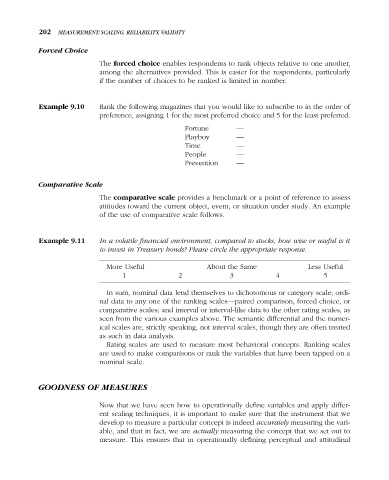
                             The forced choice enables respondents to rank objects relative to one another,
                             among the alternatives provided. This is easier for the respondents, particularly
                             if the number of choices to be ranked is limited in number.


            Example 9.10     Rank the following magazines that you would like to subscribe to in the order of
                             preference, assigning 1 for the most preferred choice and 5 for the least preferred.
                                                    Fortune        —
                                                    Playboy        —
                                                    Time           —
                                                    People         —
                                                    Prevention     —


            Comparative Scale
                             The comparative scale provides a benchmark or a point of reference to assess
                             attitudes toward the current object, event, or situation under study. An example
                             of the use of comparative scale follows.


            Example 9.11     In a volatile financial environment, compared to stocks, how wise or useful is it
                             to invest in Treasury bonds? Please circle the appropriate response.

                               More Useful                About the Same               Less Useful
                                   1               2             3            4            5

                               In sum, nominal data lend themselves to dichotomous or category scale; ordi-
                             nal data to any one of the ranking scales—paired comparison, forced choice, or
                             comparative scales; and interval or interval-like data to the other rating scales, as
                             seen from the various examples above. The semantic differential and the numer-
                             ical scales are, strictly speaking, not interval scales, though they are often treated
                             as such in data analysis.
                               Rating scales are used to measure most behavioral concepts. Ranking scales
                             are used to make comparisons or rank the variables that have been tapped on a
                             nominal scale.


            GOODNESS OF MEASURES

                             Now that we have seen how to operationally define variables and apply differ-
                             ent scaling techniques, it is important to make sure that the instrument that we
                             develop to measure a particular concept is indeed accurately measuring the vari-
                             able, and that in fact, we are actually measuring the concept that we set out to
                             measure. This ensures that in operationally defining perceptual and attitudinal

