


Page 214 - [Uma_Sekaran]_Research_methods_for_business__a_sk(BookZZ.org)
P. 214
198  MEASUREMENT: SCALING, RELIABILITY, VALIDITY

                             space, toward a particular individual, object, or event on each of the attributes.
                             The bipolar adjectives used, for instance, would employ such terms as
                             Good–Bad; Strong–Weak; Hot–Cold. The semantic differential scale is used to
                             assess respondents’ attitudes toward a particular brand, advertisement, object, or
                             individual. The responses can be plotted to obtain a good idea of their percep-
                             tions. This is treated as an interval scale. An example of the semantic differential
                             scale follows.


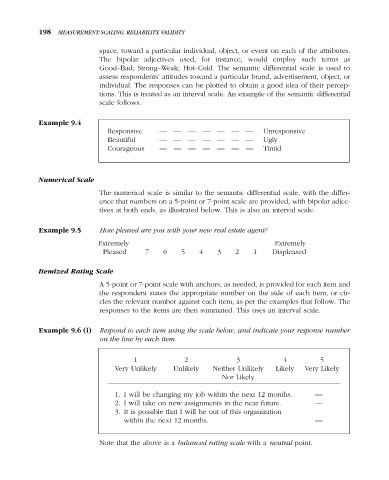
            Example 9.4
                               Responsive    ———————                      Unresponsive
                               Beautiful     ———————                      Ugly
                               Courageous    ———————                      Timid


            Numerical Scale
                             The numerical scale is similar to the semantic differential scale, with the differ-
                             ence that numbers on a 5-point or 7-point scale are provided, with bipolar adjec-
                             tives at both ends, as illustrated below. This is also an interval scale.

            Example 9.5      How pleased are you with your new real estate agent?

                            Extremely                                        Extremely
                              Pleased    7    6    5    4    3    2    1     Displeased

            Itemized Rating Scale

                             A 5-point or 7-point scale with anchors, as needed, is provided for each item and
                             the respondent states the appropriate number on the side of each item, or cir-
                             cles the relevant number against each item, as per the examples that follow. The
                             responses to the items are then summated. This uses an interval scale.


            Example 9.6 (i)  Respond to each item using the scale below, and indicate your response number
                             on the line by each item.


                                      1             2              3            4         5
                                 Very Unlikely   Unlikely   Neither Unlikely  Likely  Very Likely
                                                               Nor Likely

                                 1. I will be changing my job within the next 12 months.  —
                                 2. I will take on new assignments in the near future.  —
                                 3. It is possible that I will be out of this organization
                                   within the next 12 months.                           —


                             Note that the above is a balanced rating scale with a neutral point.

