


Page 9 - Think 3. Teacher's Book B3+
P. 9
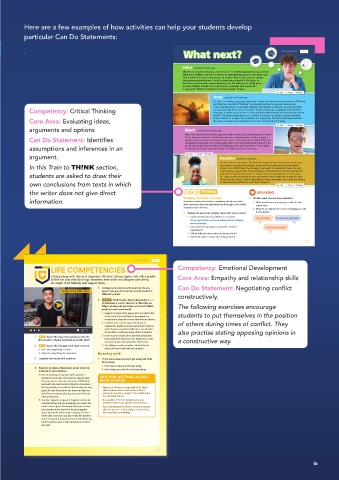
Here are a few examples of how activities can help your students develop
          particular Can Do Statements:


                                                                 What next?                          BIG DECISIONS  UNIT 1


                                                                 John  posted 2 hours ago
                                                                 My time at school is almost up, and of course I’m thinking about the big question:
                                                                 what next? Perhaps I’ve left it a bit late to start thinking about it, but that’s how
                                                                 I am. I think I’ll do well in my exams, so maybe I’ll go to university or college
                                                                 and get more qualifications – but I’ve been asking myself if it’s better to
                                                                 just find a job and start a career that way. On the other hand, if I do go on
                                                                 to study further, should I do it right away or perhaps take a year off –
                                                                 a ‘gap year’? Helpful comments and ideas, please! Thanks.
                                                                                                   Like  Share  Reply
                                                                            Amy  posted 5 minutes ago
                                                                            Hi, John. I’m doing a gap year right now. I saved up some money and went to Thailand,
                                                                            but after two months of ‘holiday’ I got bored and the money was running out.
                                                                            Then I learned about a volunteer medical organisation working in poor parts of the
           Competency: Critical Thinking                                    country and they let me join as a driver. Now I’m working, struggling with the Thai
                                                                            language (I spend up to an hour a day practising with friends) and learning lots about
                                                                            myself. I’ve made a resolution, too – when I go home, I’m going to study medicine,
           Core Area: Evaluating ideas,                                     to be a doctor or a nurse. So my advice? Do a gap year, but don’t just travel around –
                                                                            do some volunteer work somewhere. For me, it’s been life-changing.
                                                                                                   Like  Share  Reply
           arguments and options                                  Mark  posted 28 minutes ago
                                                                  Hey! I left school three months ago and I didn’t want to go to university or travel.
           Can Do Statement: Identifies                           So I’m doing a course. I’m studying to become a yoga teacher. I took up yoga a
                                                                  couple of years ago and I’ve loved it ever since. I was quite lazy at school, but I’ve
                                                                  changed my ways and now I study really hard. The course starts every day at 7.00,
           assumptions and inferences in an                       so I’ve had to get into the habit of waking up early. But that’s fine – I love what
                                                                  I’m doing. That’s the important thing – do what you love, if you can.
           argument.                                               Like  Share  Reply  Pauline  posted 1 hour ago
                                                                              Hi there! Here’s my advice. Do what feels right for you now, but keep an open
           In this Train to        section,                                   mind and be prepared to change. Some of my friends went travelling after
                                                                              school, but I didn’t have the courage; I just went to university. It was OK and
                                                                              I was having a good time. Then one day an old friend from school phoned me
           students are asked to draw their                                   and said he was going to start an online company and asked me to join him.
                                                                              So, I gave up the university course and went to work with him. It was the best
                                                                              thing I’ve ever done. I wasn’t intending to leave university, but I took the chance
           own conclusions from texts in which                                to try something different, and I don’t regret it.  Like  Share  Reply
           the writer does not give direct                                                 SPEAKING
                                                                 Reading between the lines  7  Work in pairs. Discuss these questions.
           information.                                          Sometimes a writer doesn’t tell us everything directly: we need to   1  What resolutions are you going to make for this
                                                                 draw conclusions from the information the writer gives. We call this   school year?
                                                                 ‘reading between the lines’.
                                                                                          2  What do you think is the secret of changing your life
                                                                 6  Answer the questions and give reasons for your answers.  for the better?
                                                                   0  Is John worried about his abilities as a student?  Plan carefully.   Do work first, play later.
                                                                      No, he says he’ll do well in his exams and he’s thinking
                                                                    about university.
                                                                   1  Has Amy been enjoying her work with a medical   Listen to your parents.
                                                                    organisation?
                                                                   2  Is Mark different now to when he was at school?
                                                                   3  Did Pauline want to travel after leaving school?
                                                                                                            13
                                                BREAKING AWAY  UNIT 7
                   LIFE COMPETENCIES                           Competency: Emotional Development
                   Getting along with others is important. We don’t always agree with other people   Core Area: Empathy and relationship skills
                   or like the way they do things. However, even when we disagree with them,
                   we ought to be friendly and respect them.
                                   5  Compare your answers with a partner. Do you   Can Do Statement: Negotiating conflict
                       Getting along with others  agree? Have you ever been in a similar situation?
                                     What did you do?          constructively.
                                   6   SPEAKING
                                     SPEAKING   Work in pairs. Match the solutions 1–4
                                     to situations A and B in Exercise 4. Then discuss.
                                     Which solutions do you think are the best? Which   The following exercises encourage
                                     would you not recommend?
                                     1  Suggest everyone in the group votes on which ideas
                                      to use. Both of you will have to be prepared to   students to put themselves in the position
                                      accept that it may not be your ideas that are chosen.
                                     2  Confront your teacher again and ask for an   of others during times of conflict. They
                                      explanation. Explain that your work won’t improve
                                      unless he gives you clear feedback on exactly what
                                      the problem is. Refuse to leave until it is resolved.  also practise stating opposing opinions in
             1   19   Watch the vlog. How would you describe   3  Listen to your friend’s ideas and think about how
               the situation at home between Leo and his sister?  they could work with your own. Maybe you could   a constructive way.
                                      use some of your ideas and some of hers, too.
             2   19   Watch the vlog again and make notes on:  4  Try talking to another teacher. Ask him/her for
               a  three annoying things Leo does.  advice on how to deal with the situation.
               b  three annoying things his sister does.  Me and my world
             3  Compare your notes with a partner.  7  Think of someone you don’t get along well with.
                                     Write down:
                                     1  three reasons why you don’t get along.
             4  Read the situations. Make notes about what you   2  three things you could do to change things.
               would do in each situation.
               A You are working on a project with a group of
                students in your class. You have lots of good ideas   TIPS FOR GETTING ALONG
                that you want to use, but one person is difficult to   WITH OTHERS
                work with. She also has lots of ideas for the project,
                but the problem is you don’t think her ideas are very   •  Take a bit of time to stop and think about
                good. She says that you are too bossy and that you   what someone has said or done. Don’t
                won’t listen to anyone else, because you think your   respond or react in anger. This could make
                ideas are the best.  the situation worse.
               B  You have always been good at English, in particular   •  Be positive. Think of solutions to your
                creative writing, and you usually get top marks. You   problem before you speak to the person.
                used to have a good relationship with your teacher,   •  Try to feel empathy. There may be a reason
                but recently, he has started to be quite negative   why the person is behaving a certain way.
                about your work and has even criticised it in front   Ask how they are feeling.
                of the class. Last week, you got a really bad mark for
                your homework and you don’t know why. When you
                tried to speak to your teacher about it, he seemed
                annoyed.
                                                        73
                                                                                                               ix

