


Page 6 - Think 3. Teacher's Book B3+
P. 6
Cambridge


                                Life  Competencies


          There have been many initiatives to address the skills and competencies our students need for the
          21st century – each relating to different contexts. At Cambridge, we are responding to educators
          who have asked for a way to understand how all these different approaches to life competencies
          relate to English language programmes.

          The Cambridge Framework sets out to have three dimensions:


                 BREADTH                       DEVELOPMENT                         DEPTH
                Complete view of              How the skills develop         Enough detail to guide
                transferable skills            across stages of the         teaching and assessment
                within one system                learning journey               in practical ways


          We have grouped the different competencies into six main areas.
             Creative Thinking               Learning to Learn              Collaboration
              Critical Thinking              Communication                  Social Responsibilities

          These are supported by three foundation layers that underpin the Framework:
             Emotional Development
             Digital Literacy
             Discipline Knowledge


          What Are ‘Competencies’?


          We call these ‘competencies’ rather than ‘skills’, because competencies are more than just skills.
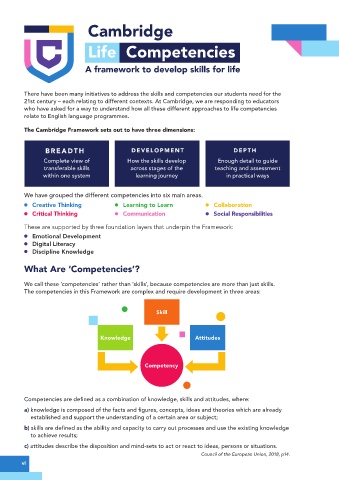
          The competencies in this Framework are complex and require development in three areas:


                                                        Skill


                                    Knowledge                         Attitudes


                                                    Competency


          Competencies are defined as a combination of knowledge, skills and attitudes, where:
          a) knowledge is composed of the facts and figures, concepts, ideas and theories which are already
            established and support the understanding of a certain area or subject;
          b) skills are defined as the ability and capacity to carry out processes and use the existing knowledge
            to achieve results;
          c) attitudes describe the disposition and mind-sets to act or react to ideas, persons or situations.
                                                                        Council of the European Union, 2018, p14.
         vi

