


Page 305 - JoFA_2022
P. 305
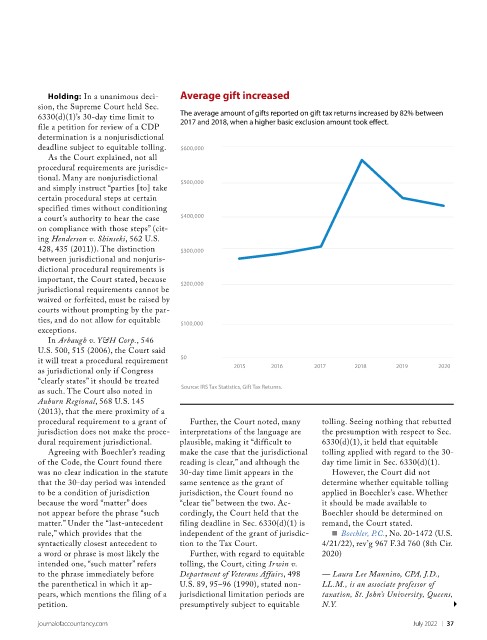
Average gift increased
            Holding: In a unanimous deci-
          sion, the Supreme Court held Sec.
                                            The average amount of gifts reported on gift tax returns increased by 82% between
          6330(d)(1)’s 30-day time limit to
                                            2017 and 2018, when a higher basic exclusion amount took effect.
          file a petition for review of a CDP
          determination is a nonjurisdictional
          deadline subject to equitable tolling.  $600,000
            As the Court explained, not all
          procedural requirements are jurisdic-
          tional. Many are nonjurisdictional
                                            $500,000
          and simply instruct “parties [to] take
          certain procedural steps at certain
          specified times without conditioning
                                            $400,000
          a court’s authority to hear the case
          on compliance with those steps” (cit-
          ing Henderson v. Shinseki, 562 U.S.
          428, 435 (2011)). The distinction   $300,000
          between jurisdictional and nonjuris-
          dictional procedural requirements is
          important, the Court stated, because
                                            $200,000
          jurisdictional requirements cannot be
          waived or forfeited, must be raised by
          courts without prompting by the par-
          ties, and do not allow for equitable   $100,000
          exceptions.
            In Arbaugh v. Y&H Corp., 546
          U.S. 500, 515 (2006), the Court said
                                            $0
          it will treat a procedural requirement
                                                        2015     2016      2017      2018      2019      2020
          as jurisdictional only if Congress
          “clearly states” it should be treated
                                            Source: IRS Tax Statistics, Gift Tax Returns.
          as such. The Court also noted in
          Auburn Regional, 568 U.S. 145
          (2013), that the mere proximity of a
          procedural requirement to a grant of   Further, the Court noted, many   tolling. Seeing nothing that rebutted
          jurisdiction does not make the proce-  interpretations of the language are   the presumption with respect to Sec.
          dural requirement jurisdictional.   plausible, making it “difficult to   6330(d)(1), it held that equitable
            Agreeing with Boechler’s reading   make the case that the jurisdictional   tolling applied with regard to the 30-
          of the Code, the Court found there   reading is clear,” and although the   day time limit in Sec. 6330(d)(1).
          was no clear indication in the statute   30-day time limit appears in the   However, the Court did not
          that the 30-day period was intended   same sentence as the grant of   determine whether equitable tolling
          to be a condition of jurisdiction   jurisdiction, the Court found no   applied in Boechler’s case. Whether
          because the word “matter” does    “clear tie” between the two. Ac-  it should be made available to
          not appear before the phrase “such   cordingly, the Court held that the   Boechler should be determined on
          matter.” Under the “last-antecedent   filing deadline in Sec. 6330(d)(1) is   remand, the Court stated.
          rule,” which provides that the    independent of the grant of jurisdic-  ■   Boechler, P.C., No. 20-1472 (U.S.
          syntactically closest antecedent to   tion to the Tax Court.       4/21/22), rev’g 967 F.3d 760 (8th Cir.
          a word or phrase is most likely the   Further, with regard to equitable   2020)
          intended one, “such matter” refers   tolling, the Court, citing Irwin v.
          to the phrase immediately before   Department of Veterans Affairs, 498   — Laura Lee Mannino, CPA, J.D.,
          the parenthetical in which it ap-  U.S. 89, 95–96 (1990), stated non-  LL.M., is an associate professor of
          pears, which mentions the filing of a   jurisdictional limitation periods are   taxation, St. John’s University, Queens,
          petition.                         presumptively subject to equitable   N.Y.

          journalofaccountancy.com                                                                 July 2022    |   37

