


Page 393 - JoFA_2022
P. 393
TAX MATTERS


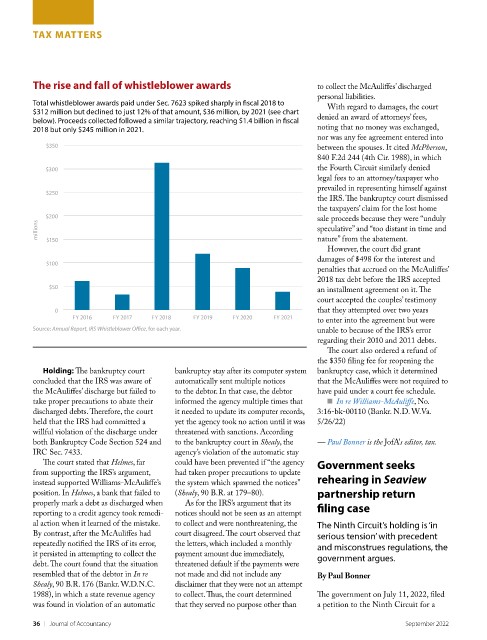
         The rise and fall of whistleblower awards                          to collect the McAuliffes’ discharged
                                                                            personal liabilities.
         Total whistleblower awards paid under Sec. 7623 spiked sharply in fiscal 2018 to
         $312 million but declined to just 12% of that amount, $36 million, by 2021 (see chart   With regard to damages, the court
         below). Proceeds collected followed a similar trajectory, reaching $1.4 billion in fiscal   denied an award of attorneys’ fees,
         2018 but only $245 million in 2021.                                noting that no money was exchanged,
                                                                            nor was any fee agreement entered into
            $350                                                            between the spouses. It cited McPherson,
                                                                            840 F.2d 244 (4th Cir. 1988), in which
            $300                                                            the Fourth Circuit similarly denied
                                                                            legal fees to an attorney/taxpayer who
                                                                            prevailed in representing himself against
            $250
                                                                            the IRS. The bankruptcy court dismissed
                                                                            the taxpayers’ claim for the lost home
            $200                                                            sale proceeds because they were “unduly
          millions  $150                                                    speculative” and “too distant in time and

                                                                            nature” from the abatement.
                                                                              However, the court did grant
                                                                            damages of $498 for the interest and
            $100
                                                                            penalties that accrued on the McAuliffes’
                                                                            2018 tax debt before the IRS accepted
             $50
                                                                            an installment agreement on it. The
                                                                            court accepted the couples’ testimony
              0                                                             that they attempted over two years
                  FY 2016   FY 2017   FY 2018   FY 2019   FY 2020   FY 2021
                                                                            to enter into the agreement but were
         Source: Annual Report, IRS Whistleblower Office, for each year.    unable to because of the IRS’s error
                                                                            regarding their 2010 and 2011 debts.
                                                                              The court also ordered a refund of
                                                                            the $350 filing fee for reopening the
           Holding: The bankruptcy court   bankruptcy stay after its computer system   bankruptcy case, which it determined
         concluded that the IRS was aware of   automatically sent multiple notices   that the McAuliffes were not required to
         the McAuliffes’ discharge but failed to   to the debtor. In that case, the debtor   have paid under a court fee schedule.
         take proper precautions to abate their   informed the agency multiple times that   ■   In re Williams-McAuliffe, No.
         discharged debts. Therefore, the court   it needed to update its computer records,   3:16-bk-00110 (Bankr. N.D. W.Va.
         held that the IRS had committed a   yet the agency took no action until it was   5/26/22)
         willful violation of the discharge under   threatened with sanctions. According
         both Bankruptcy Code Section 524 and   to the bankruptcy court in Shealy, the   — Paul Bonner is the JofA’s editor, tax.
         IRC Sec. 7433.                   agency’s violation of the automatic stay
                                                                            Government seeks
           The court stated that Helmes, far   could have been prevented if “the agency
         from supporting the IRS’s argument,   had taken proper precautions to update   rehearing in Seaview
         instead supported Williams-McAuliffe’s   the system which spawned the notices”
                                                                            partnership return
         position. In Helmes, a bank that failed to   (Shealy, 90 B.R. at 179–80).
         properly mark a debt as discharged when   As for the IRS’s argument that its   filing case
         reporting to a credit agency took remedi-  notices should not be seen as an attempt
         al action when it learned of the mistake.   to collect and were nonthreatening, the   The Ninth Circuit’s holding is ‘in
         By contrast, after the McAuliffes had   court disagreed. The court observed that   serious tension’ with precedent
         repeatedly notified the IRS of its error,   the letters, which included a monthly   and misconstrues regulations, the
         it persisted in attempting to collect the   payment amount due immediately,   government argues.
         debt. The court found that the situation   threatened default if the payments were
         resembled that of the debtor in In re   not made and did not include any   By Paul Bonner
         Shealy, 90 B.R. 176 (Bankr. W.D.N.C.   disclaimer that they were not an attempt
         1988), in which a state revenue agency   to collect. Thus, the court determined   The government on July 11, 2022, filed
         was found in violation of an automatic   that they served no purpose other than   a petition to the Ninth Circuit for a

         36    |   Journal of Accountancy                                                        September 2022

