


Page 429 - JoFA_2022
P. 429
TECHNOLOGY


         as the underlying file to generate an NFT hash   How NFTs generate accounting events
         value that is linked to the blockchain record. The
         file’s hash value becomes part of the NFT.
                                                     ACTION                        ACCOUNTING
         NFTs GENERATE REVENUE AND CREATE VALUE
         CPAs should be aware that NFTs can be used
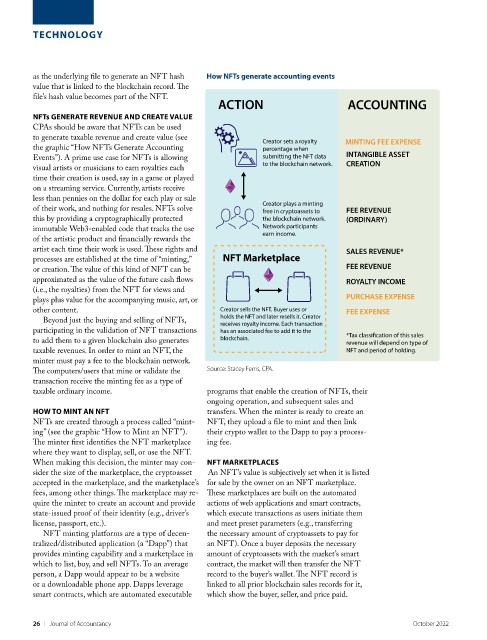
         to generate taxable revenue and create value (see
                                                               Creator sets a royalty  MINTING FEE EXPENSE
         the graphic “How NFTs Generate Accounting             percentage when
         Events”). A prime use case for NFTs is allowing       submitting the NFT data   INTANGIBLE ASSET
                                                               to the blockchain network.  CREATION
         visual artists or musicians to earn royalties each
         time their creation is used, say in a game or played
         on a streaming service. Currently, artists receive
         less than pennies on the dollar for each play or sale
                                                               Creator plays a minting
         of their work, and nothing for resales. NFTs solve    free in cryptoassets to   FEE REVENUE
         this by providing a cryptographically protected       the blockchain network.   (ORDINARY)
                                                               Network participants
         immutable Web3-enabled code that tracks the use
                                                               earn income.
         of the artistic product and financially rewards the
         artist each time their work is used. These rights and                     SALES REVENUE*
         processes are established at the time of “minting,”   NFT Marketplace
                                                                                   FEE REVENUE
         or creation. The value of this kind of NFT can be
         approximated as the value of the future cash flows                        ROYALTY INCOME
         (i.e., the royalties) from the NFT for views and
                                                                                   PURCHASE EXPENSE
         plays plus value for the accompanying music, art, or
         other content.                              Creator sells the NFT. Buyer uses or   FEE EXPENSE
                                                     holds the NFT and later resells it. Creator
           Beyond just the buying and selling of NFTs,
                                                     receives royalty income. Each transaction
         participating in the validation of NFT transactions   has an associated fee to add it to the
                                                     blockchain.                   *Tax classi cation of this sales
         to add them to a given blockchain also generates                          revenue will depend on type of
         taxable revenues. In order to mint an NFT, the                            NFT and period of holding.
         minter must pay a fee to the blockchain network.
                                                  Source: Stacey Ferris, CPA.
         The computers/users that mine or validate the
         transaction receive the minting fee as a type of
         taxable ordinary income.                 programs that enable the creation of NFTs, their
                                                  ongoing operation, and subsequent sales and
         HOW TO MINT AN NFT                       transfers. When the minter is ready to create an
         NFTs are created through a process called “mint-  NFT, they upload a file to mint and then link
         ing” (see the graphic “How to Mint an NFT”).   their crypto wallet to the Dapp to pay a process-
         The minter first identifies the NFT marketplace   ing fee.
         where they want to display, sell, or use the NFT.
         When making this decision, the minter may con-  NFT MARKETPLACES
         sider the size of the marketplace, the cryptoasset   An NFT’s value is subjectively set when it is listed
         accepted in the marketplace, and the marketplace’s  for sale by the owner on an NFT marketplace.
         fees, among other things. The marketplace may re-  These marketplaces are built on the automated
         quire the minter to create an account and provide   actions of web applications and smart contracts,
         state-issued proof of their identity (e.g., driver’s   which execute transactions as users initiate them
         license, passport, etc.).                and meet preset parameters (e.g., transferring
           NFT minting platforms are a type of decen-  the necessary amount of cryptoassets to pay for
         tralized/distributed application (a “Dapp”) that   an NFT). Once a buyer deposits the necessary
         provides minting capability and a marketplace in   amount of cryptoassets with the market’s smart
         which to list, buy, and sell NFTs. To an average   contract, the market will then transfer the NFT
         person, a Dapp would appear to be a website   record to the buyer’s wallet. The NFT record is
         or a downloadable phone app. Dapps leverage   linked to all prior blockchain sales records for it,
         smart contracts, which are automated executable   which show the buyer, seller, and price paid.


         26    |   Journal of Accountancy                                                          October 2022

