


Page 43 - JoFA_2022
P. 43
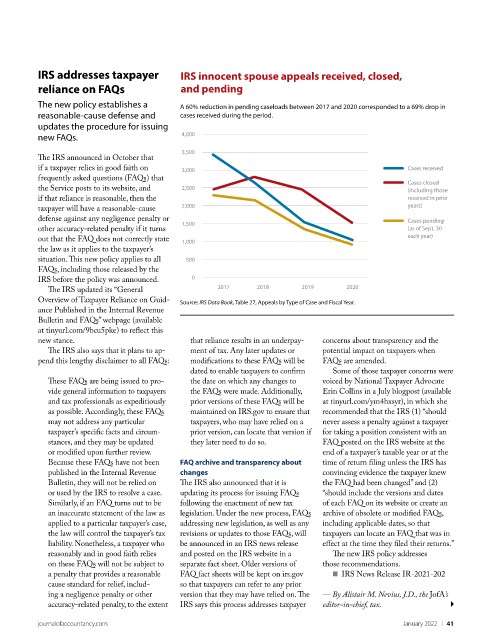
IRS addresses taxpayer            IRS innocent spouse appeals received, closed,
          reliance on FAQs                  and pending

          The new policy establishes a      A 60% reduction in pending caseloads between 2017 and 2020 corresponded to a 69% drop in
          reasonable-cause defense and      cases received during the period.
          updates the procedure for issuing
          new FAQs.                         4,000
                                            3,500
          The IRS announced in October that
          if a taxpayer relies in good faith on   3,000                                          Cases received
          frequently asked questions (FAQs) that
                                                                                                 Cases closed
          the Service posts to its website, and   2,500                                          (including those
          if that reliance is reasonable, then the                                               received in prior
                                            2,000                                                years)
          taxpayer will have a reasonable-cause
          defense against any negligence penalty or                                              Cases pending
                                            1,500
          other accuracy-related penalty if it turns                                             (as of Sept. 30
                                                                                                 each year)
          out that the FAQ does not correctly state   1,000
          the law as it applies to the taxpayer’s
          situation. This new policy applies to all   500
          FAQs, including those released by the
          IRS before the policy was announced.  0
                                                     2017     2018      2019       2020
            The IRS updated its “General
          Overview of Taxpayer Reliance on Guid-  Source: IRS Data Book, Table 27, Appeals by Type of Case and Fiscal Year.
          ance Published in the Internal Revenue
          Bulletin and FAQs” webpage (available
          at tinyurl.com/9bcu5pke) to reflect this
          new stance.                         that reliance results in an underpay-  concerns about transparency and the
            The IRS also says that it plans to ap-  ment of tax. Any later updates or   potential impact on taxpayers when
          pend this lengthy disclaimer to all FAQs:  modifications to these FAQs will be   FAQs are amended.
                                              dated to enable taxpayers to confirm   Some of those taxpayer concerns were
            These FAQs are being issued to pro-  the date on which any changes to   voiced by National Taxpayer Advocate
            vide general information to taxpayers   the FAQs were made. Additionally,   Erin Collins in a July blogpost (available
            and tax professionals as expeditiously   prior versions of these FAQs will be   at tinyurl.com/ym4hxsyr), in which she
            as possible. Accordingly, these FAQs   maintained on IRS.gov to ensure that   recommended that the IRS (1) “should
            may not address any particular    taxpayers, who may have relied on a   never assess a penalty against a taxpayer
            taxpayer’s specific facts and circum-  prior version, can locate that version if   for taking a position consistent with an
            stances, and they may be updated   they later need to do so.     FAQ posted on the IRS website at the
            or modified upon further review.                                 end of a taxpayer’s taxable year or at the
            Because these FAQs have not been   FAQ archive and transparency about   time of return filing unless the IRS has
            published in the Internal Revenue   changes                      convincing evidence the taxpayer knew
            Bulletin, they will not be relied on   The IRS also announced that it is   the FAQ had been changed” and (2)
            or used by the IRS to resolve a case.   updating its process for issuing FAQs   “should include the versions and dates
            Similarly, if an FAQ turns out to be   following the enactment of new tax   of each FAQ on its website or create an
            an inaccurate statement of the law as   legislation. Under the new process, FAQs   archive of obsolete or modified FAQs,
            applied to a particular taxpayer’s case,   addressing new legislation, as well as any   including applicable dates, so that
            the law will control the taxpayer’s tax   revisions or updates to those FAQs, will   taxpayers can locate an FAQ that was in
            liability. Nonetheless, a taxpayer who   be announced in an IRS news release   effect at the time they filed their returns.”
            reasonably and in good faith relies   and posted on the IRS website in a   The new IRS policy addresses
            on these FAQs will not be subject to   separate fact sheet. Older versions of   those recommendations.
            a penalty that provides a reasonable   FAQ fact sheets will be kept on irs.gov   ■   IRS News Release IR-2021-202
            cause standard for relief, includ-  so that taxpayers can refer to any prior
            ing a negligence penalty or other   version that they may have relied on. The   — By Alistair M. Nevius, J.D., the JofA’s
            accuracy-related penalty, to the extent   IRS says this process addresses taxpayer   editor-in-chief, tax.

          journalofaccountancy.com                                                              January 2022    |   41

