


Page 476 - JoFA_2022
P. 476
Secs. 41 and 174. In other words, specified R&E   increase with respect to states that have adopted
             expenditures for the credit under Sec. 41 must first   or conformed to the new federal rule. In addition,
             be included in specified R&E expenditures under   affected taxpayers need to consider the changes and
             Sec. 174. Prior to the TCJA, the Sec. 41 credit only   adjustments that will occur to financial reporting
             required that R&E expenditures were eligible for   because of this rule change as well as the adjust-
             Sec. 174 treatment.                      ments occurring in other areas of tax reporting
               The TCJA also made a conforming amendment   and liability. The first few years of this change will
             to Sec. 280C(c), which precludes taxpayers from   present some challenges. However, as time passes,
             receiving a double benefit. Sec. 280C(c)(1) provides   the impact of this rule change should diminish.
             that if the amount of the credit under Sec. 41(a)(1)   For taxpayers with a relatively stable R&E
             exceeds the amount allowable as a deduction for   pattern, the amount of currently deductible R&E
             a tax year for qualified research expenses or basic   expenditures will approach the levels that were
             research expenses, then the amount chargeable to   deductible before this change.
             capital account for the tax year for such expenses
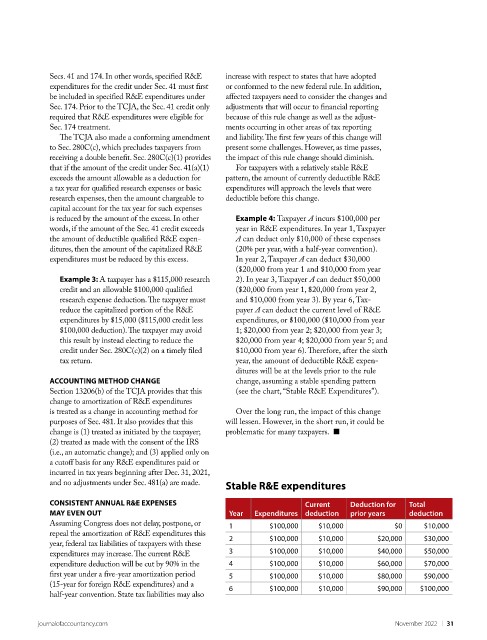
             is reduced by the amount of the excess. In other   Example 4: Taxpayer A incurs $100,000 per
             words, if the amount of the Sec. 41 credit exceeds   year in R&E expenditures. In year 1, Taxpayer
             the amount of deductible qualified R&E expen-  A can deduct only $10,000 of these expenses
             ditures, then the amount of the capitalized R&E   (20% per year, with a half-year convention).
             expenditures must be reduced by this excess.   In year 2, Taxpayer A can deduct $30,000
                                                         ($20,000 from year 1 and $10,000 from year
               Example 3: A taxpayer has a $115,000 research   2). In year 3, Taxpayer A can deduct $50,000
               credit and an allowable $100,000 qualified   ($20,000 from year 1, $20,000 from year 2,
               research expense deduction. The taxpayer must   and $10,000 from year 3). By year 6, Tax-
               reduce the capitalized portion of the R&E   payer A can deduct the current level of R&E
               expenditures by $15,000 ($115,000 credit less   expenditures, or $100,000 ($10,000 from year
               $100,000 deduction). The taxpayer may avoid   1; $20,000 from year 2; $20,000 from year 3;
               this result by instead electing to reduce the   $20,000 from year 4; $20,000 from year 5; and
               credit under Sec. 280C(c)(2) on a timely filed   $10,000 from year 6). Therefore, after the sixth
               tax return.                               year, the amount of deductible R&E expen-
                                                         ditures will be at the levels prior to the rule
             ACCOUNTING METHOD CHANGE                    change, assuming a stable spending pattern
             Section 13206(b) of the TCJA provides that this   (see the chart, “Stable R&E Expenditures”).
             change to amortization of R&E expenditures
             is treated as a change in accounting method for   Over the long run, the impact of this change
             purposes of Sec. 481. It also provides that this   will lessen. However, in the short run, it could be
             change is (1) treated as initiated by the taxpayer;   problematic for many taxpayers.  ■
             (2) treated as made with the consent of the IRS
             (i.e., an automatic change); and (3) applied only on
             a cutoff basis for any R&E expenditures paid or
             incurred in tax years beginning after Dec. 31, 2021,
                                                      Stable R&E expenditures
             and no adjustments under Sec. 481(a) are made.
             CONSISTENT ANNUAL R&E EXPENSES                              Current    Deduction for   Total
             MAY EVEN OUT                              Year  Expenditures deduction  prior years  deduction
             Assuming Congress does not delay, postpone, or   1  $100,000   $10,000           $0     $10,000
             repeal the amortization of R&E expenditures this
                                                       2         $100,000   $10,000       $20,000    $30,000
             year, federal tax liabilities of taxpayers with these
                                                       3         $100,000   $10,000       $40,000    $50,000
             expenditures may increase. The current R&E
             expenditure deduction will be cut by 90% in the   4  $100,000  $10,000       $60,000    $70,000
             first year under a five-year amortization period   5  $100,000  $10,000      $80,000    $90,000
             (15-year for foreign R&E expenditures) and a
                                                       6         $100,000   $10,000       $90,000   $100,000
             half-year convention. State tax liabilities may also


          journalofaccountancy.com                                                            November 2022    |   31

