


Page 2 - Demo-1
P. 2
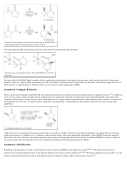
Asymmetric hydrogenation of dicarbonyl systems using an (R)-BINAP-Ru catalyst. Epimerization is obtained through 2 equiv. of LDA.
Transition states of dicarbonyl systems. (P-P= (R)-BINAP, X= Cl, H, H2, or solvent)
1,4 conjugate reduction to cyclic enones.
To further understand the stereochemical outcome, one must look at the transition state geometry.
The steric bulk of the BINAP ligand coupled with the coordination of ruthenium to the carbonyl oxygen atoms results in high selectivity for hydrogen insertion on one face. This resulting stereochemistry of (R,S) and (R,R) is obtained in 94.5% yield while the other three stereoisomers range from 0.5-3% yield. Noyori’s accomplishments of 1990 paved the way for even more useful applications of DKR.
Asymmetric Conjugate Reduction
About a decade later, Jurkauskas and Buchwald also utilized dynamic kinetic resolution towards the hydrogenation of conjugated systems.[8] 1,4 addition to cyclic enones is quite common in many reaction schemes, however asymmetric reductions in the presence of an easily epimerizable center adds to the complexity when trying to modify only one center. Through the use of a copper catalyzed reaction however, Buchwald was able to obtain 1,4 reduction in great enantiomeric excess (ee). In order to achieve a high rate of epimerization, a strong bulky base like sodium t-butoxide was used to ensure rapid equilibrium.
Copper proved to be an excellent metal in this reaction due to its ability to complex with the oxygen when the hydrogen was added. Being a soft metal, copper greatly prefers 1,4 addition over 1,2 addition, with the alkene being a softer more polarizable electrophile. Again, BINAP became the ligand of choice due to its steric selectivity, lowering the transition state energy of starting material in the left column. In addition, PMHS was used as a relatively less reactive silane. This prevented loss of ee before deprotection with tetra-n-butylammonium fluoride (TBAF).
Asymmetric Aldol Reaction
In addition to hydrogenation reactions, other bonds have been formed using DKR and are highly successful.[9][10][11] The aldol reaction has been extensively researched primarily because of the inherent challenge of forming a carbon-carbon bond.[12][13] Ward and colleagues have been able to use the proline-catalyzed aldol reaction in tandem with dynamic kinetic resolution to obtain a high enantioselective reaction.[14]


