


Page 1 - Demo-1
P. 1
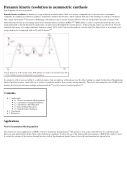
Energy diagram of an (R) and (S) isomer. With addition of a catalyst, one transition state (TS) is lower and thus becomes the kinetically favored pathway.
Contents
1 Applications
1.1 Noyori Asymmetric Hydrogenation 1.2 Asymmetric Conjugate Reduction 1.3 Asymmetric Aldol Reaction
1.4 Enzyme-Metal Reactions
1.5 Natural Product Synthesis
2 Conclusion 3 References
Dynamic kinetic resolution in asymmetric synthesis
From Wikipedia, the free encyclopedia
Dynamic kinetic resolution in chemistry is a type of kinetic resolution where 100% of a racemic compound can be converted into a enantiopure compound. It is applied in asymmetric synthesis. Asymmetric synthesis has become a much explored field due to the challenge of creating a compound
with a single 3D structure.[1] Even more challenging is the ability to take a racemic mixture and have only one chiral product left after a reaction. One
method that has become an exceedingly useful tool is dynamic kinetic resolution (DKR).[2][3] DKR utilizes a center of a particular molecule that can be easily epimerized so that the (R) and (S) enantiomers can interconvert throughout the reaction process. At this point the catalyst can selectively lower the transition state energy of a single enantiomer, leading to almost 100% yield of one reaction pathway over the other. The figure below is an example of an
energy diagram for a compound with an (R) and (S) isomer.[4]
If a catalyst is able to increase ΔΔG≠ to a sufficient degree, then one pathway will dominate over the other, leading to a single chiral product. Manipulating kinetics therefore becomes a powerful way to achieve asymmetric products from racemic starting materials. There have been numerous uses of DKR in the
literature that have provided new methods in pharmaceuticals[5] as well as routes to natural products.[6]
Applications
Noyori Asymmetric Hydrogenation
One of the more classic applications of DKR is Noyori’s asymmetric hydrogenation.[7] The presence of an acidic center between two carbonyl groups allows for easy epimerization at the chiral center under basic conditions. To select for one of the four possible stereoisomers, a BINAP-Ru catalyst is used to control the outcome of the reaction through the steric bulk of the phosphorus ligand. Some of the early transformations are shown below.


