


Page 15 - AYUR
P. 15
PROCESS


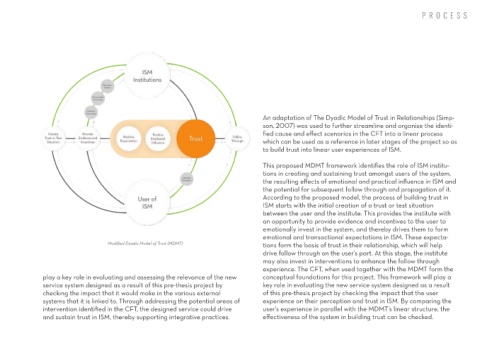
 Frameworks wide enough to accommodate for the human-centred                                 An adaptation of The Dyadic Model of Trust in Relationships (Simp-
 aspects, while being narrow and specific enough to not lose focus of                         son, 2007) was used to further streamline and organise the identi-
 the design challenge are an essential foundation for this project.                          fied cause and effect scenarios in the CFT into a linear process
 During the course of defining the design challenge, research was                             which can be used as a reference in later stages of the project so as
 conducted within the initially chosen umbrella of ‘perception of ISM in                     to build trust into linear user experiences of ISM.
 urban India’. Secondary research was carried out in the area of
 frameworks for trust, history of Indian healthcare, existing work on                        This proposed MDMT framework identifies the role of ISM institu-
 creating trust in systems, and on the current context of healthcare                         tions in creating and sustaining trust amongst users of the system,
 and alternative medicine in India. Initial primary research for this                        the resulting effects of emotional and practical influence in ISM and
 project was carried out through a series of twelve deep-dive inter-                         the potential for subsequent follow through and propagation of it.
 views across two institutions, out of which two led to much deeper                          According to the proposed model, the process of building trust in
 conversations on Ayurveda and Yoga.                                                         ISM starts with the initial creation of a trust or test situation
                                                                                             between the user and the institute. This provides the institute with
 Through a series of iterations using affinity- and mind-mapping of the                        an opportunity to provide evidence and incentives to the user to
 research observations, the cause and effect relationships of different                        emotionally invest in the system, and thereby drives them to form
 elements of ‘the perception of ISM in urban India’ were identified,                          emotional and transactional expectations in ISM. These expecta-
 which were then mapped using a stock and flow model (Meadows   Modified Dyadic Model of Trust (MDMT)  tions form the basis of trust in their relationship, which will help
 2008).  Below is the visual mapping of the proposed, Causal Frame-                          drive follow through on the user’s part. At this stage, the institute
 work for Trust (CFT) in Indian Systems of Medicine, as derived                              may also invest in interventions to enhance the follow through
 through the above mentioned process.                                                        experience. The CFT, when used together with the MDMT form the
 whose value depends on the factors which flow in and out of it. A gain in   play a key role in evaluating and assessing the relevance of the new   conceptual foundations for this project. This framework will play a
 The CFT identifies the cause and effect relationships of multiple   this ‘stock’ of trust is then used to drive the primary cycle of follow   service system designed as a result of this pre-thesis project by   key role in evaluating the new service system designed as a result
 factors of the perception of ISM at primary, secondary and tertiary   through which goes on to reinforce the positive perception of ISM in the   checking the impact that it would make in the various external   of this pre-thesis project by checking the impact that the user
 levels in relation to ISM, and also identifies the potential areas for   urban Indian context. Through this model, a range of factors can be   systems that it is linked to. Through addressing the potential areas of   experience on their perception and trust in ISM. By comparing the
 intervention to drive and sustain a system of trust in ISM. Within the   seen as being contributors to building trust in the system, and relevant   intervention identified in the CFT, the designed service could drive   user’s experience in parallel with the MDMT’s linear structure, the
 stock and flow model, the aspect of trust is seen as a variable stock   opportunities for intervention can also be identified. This framework will   and sustain trust in ISM, thereby supporting integrative practices.  effectiveness of the system in building trust can be checked.

