


Page 39 - 2018 Powerlist
P. 39
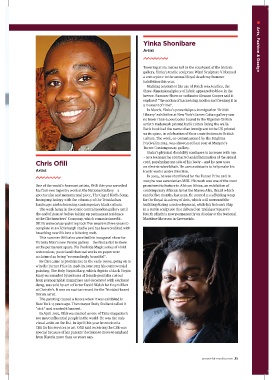
Yinka Shonibare
                                                                    Artist                                                 Arts, Fashion & Design


                                                                    Towering at six metres tall in the courtyard of the historic
                                                                    gallery, Yinka’s textile sculpture Wind Sculpture VI formed
                                                                    a centrepiece to the annual Royal Academy Summer
                                                                    Exhibition this year.
                                                                     Marking a return to his use of Dutch wax textiles, the
                                                                    three-dimensional piece of fabric appeared to blow in the
                                                                    breeze. Summer Show co-ordinator Eleanor Cooper said it
                                                                    explored “the notion of harnessing motion and freezing it in
                                                                    a moment of time”.
                                                                     In March, Yinka’s powerful pro-immigration ‘British
                                                                    Library’ exhibition at New York’s James Cohan gallery saw
                                                                    no fewer than 6,000 books bound in the Nigerian-British
                                                                    artist’s trademark printed batik cotton lining the walls.
                                                                    Each book had the name of an immigrant to the UK printed
                                                                    on its spine, in celebration of their contributions to British
                                                                    culture. The work, co-commissioned by the Brighton
                                                                    Festival in 2014, was showcased last year at Margate’s
                                                                    Turner Contemporary gallery.
                                                                     Yinka’s physical disability continues to increase with age
                                                                    – as a teenager he contracted an inflammation of the spinal
                  Chris Ofili                                       cord, paralysing one side of his body – and he now uses
                                                                    an electric wheelchair. He uses assistants to help make his
                  Artist                                            iconic works under direction.
                                                                     In 2004, he was shortlisted for the Turner Prize and in
                                                                    2003 he was awarded an MBE. His work was one of the most
                  One of the world’s foremost artists, Ofili this year unveiled   prominent to feature in African Africa, an exhibition of
                  his first-ever tapestry work at the National Gallery – a   contemporary African Art at the Museu Afro, Brazil which
                  spectacular and monumental piece, The Caged Bird’s Song,   ran for five months last year. He created a scaffolding wrap
                  fusing mythology with the vibrancy of the Trinidadian   for the Royal Academy of Arts, which will surround the
                  landscape and referencing contemporary black culture.  building during a redevelopment, while his Nelson’s Ship
                   The work hung in the iconic central London gallery until   in a Bottle sculpture that debuted on Trafalgar Square’s
                  the end of August before taking up permanent residence   fourth plinth is now permanently on display at the National
                  at the Clothworkers’ Company, which commissioned it.   Maritime Museum in Greenwich.
                  Ofili’s watercolour painting took five weavers three years to
                  complete in an Edinburgh studio and has been credited with
                  breathing new life into a faltering craft.
                   This summer Ofili also unveiled his inaugural show for
                  Victoria Miro’s new Venice gallery – the first artist to show
                  at the permanent space. His Poolside Magic series of vivid
                  watercolour, pastel and charcoal works on paper were
                  acclaimed as being “resoundingly beautiful”.
                   He first came to prominence in the early 1990s, going on to
                  win the Turner Prize in 1998. In June 2015 his controversial
                  painting, The Holy Virgin Mary, which depicts a black Virgin
                  Mary surrounded by pictures of female genitalia cut out
                  from pornographic magazines and decorated with elephant
                  dung, was sold by art collector David Walsh for £2.9 million
                  at Christie’s. It was an auction record for the Trinidad-based
                  British artist.
                   The painting caused a furore when it was exhibited in
                  New York 15 years ago. Then mayor Rudy Giuliani called it
                  “sick” and wanted it banned.
                   In April 2015, Ofili was named as one of Time magazine’s
                  100 most influential people in the world. He was the only
                  visual artist on the list. In April this year he received a
                  CBE for his services to art. Ofili said receiving the CBE was
                  special because of his parents’ decision to move to England
                  from Nigeria more than 40 years ago.


                                                                                               powerful-media.com  35

