


Page 25 - MNLGA Free State Winter 2025
P. 25
IT'S TIME FOR SHARING A Jerry Faulring


        COMPOST:


        Still the


        Black


        Gold of


        Agriculture


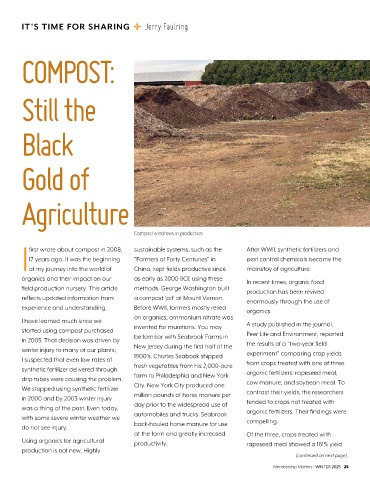
                                             Compost windrows in production
        I                                    sustainable systems, such as the      After WWII, synthetic fertilizers and
           first wrote about compost in 2008,
           17 years ago. It was the beginning
                                             "Farmers of Forty Centuries" in
                                                                                   pest control chemicals became the
           of my journey into the world of
                                             as early as 2000 BCE using these
        organics and their impact on our     China, kept fields productive since   mainstay of agriculture.
                                                                                   In recent times, organic food
        field production nursery. This article   methods. George Washington built
                                                                                   production has been revived
        reflects updated information from    a compost ‘pit’ at Mount Vernon.
                                                                                   enormously through the use of
        experience and understanding.        Before WWII, farmers mostly relied
                                                                                   organics.
                                             on organics; ammonium nitrate was
        I have learned much since we                                               A study published in the journal,
                                             invented for munitions. You may
        started using compost purchased                                            Peer Life and Environment, reported
                                             be familiar with Seabrook Farms in
        in 2005. That decision was driven by                                       the results of a "two-year field
                                             New Jersey during the first half of the
        winter injury to many of our plants;                                       experiment" comparing crop yields
                                             1900’s. Charles Seabook shipped
        I suspected that even low rates of                                         from crops treated with one of three
                                             fresh vegetables from his 2,000-acre
        synthetic fertilizer delivered through                                     organic fertilizers: rapeseed meal,
                                             farm to Philadelphia and New York
        drip tubes were causing the problem.                                       cow manure, and soybean meal. To
                                             City. New York City produced one
        We stopped using synthetic fertilizer                                      contrast their yields, the researchers
                                             million pounds of horse manure per
        in 2000 and by 2003 winter injury                                          tended to crops not treated with
                                             day prior to the widespread use of
        was a thing of the past. Even today,                                       organic fertilizers. Their findings were
                                             automobiles and trucks. Seabrook
        with some severe winter weather we                                         compelling.
                                             back-hauled horse manure for use
        do not see injury.
                                             at the farm and greatly increased     Of the three, crops treated with
        Using organics for agricultural      productivity.                         rapeseed meal showed a 161% yield
        production is not new. Highly
                                                                                                   (continued on next page)

                                                                                             Membership Matters • WINTER 2025   25

