


Page 29 - MNLGA Free State Winter 2025
P. 29
their heads on the ceiling; probably   Our methodology is to watch the     type of compost we make contains
        go to jail for that today.           temperature. When I consider it       ample fertility for plant production
                                             ready for the field it still has some   over a period of many years.
        Horse manure, it turns out, is the
                                             pieces of wood chips visible but looks   Sometimes when we tour a customer
        best compost source for us. The
                                             and smells great! Gourmet compost     and tell them we don’t use any
        mineralization rate for horse manure
                                             does not reveal any source materials.   synthetic fertilizer, they think we are
        is ten years while some sources can
                                             After 18-24 months of mixing and      lying when they see the ample color
        be only one year. It also produces
                                             ‘cooking’, the temperature stabilizes   and robust nature of our plants.
        a fungal based compost favored
                                             at 90-100 degrees F. We see initial
        by woody plants. Bacterial based                                           To resolve the cost issue of compost,
                                             temperatures of up to 160 degrees
        compost is more useful for flowers,                                        we can’t afford to buy it, but we can
                                             fahrenheit which kills most weed
        vegetables, and grasses.                                                   afford it if we make it. A
                                             seeds and other bad things.
        Our compost production system
                                             Not counting my time, I guestimate
        requires 18-24 months, turning the
                                             we are spending about $4.00 per
        windrows based on temperature.
                                             ton for what I call finished compost.
        The manure is free. We also receive
                                             That brings the material cost down
        arborist wood chips for free and mix
                                             to about $400 per acre versus $1,475
        them with manure while building
                                             per acre for purchased material. If we
        windrows. Our additional cost
                                             assume a six-year planting rotation,
        is windrow management which                                                  Jerry Faulring
                                             the annual cost is less than $70 per
        includes the cost of equipment,                                              Waverly Farm
                                             acre, less than synthetic fertilizer. The
        depreciation, fuel and an operator.                                          1931 Greenfield Road
                                                                                     Adamstown, MD 21710
                                                                                     310-874-8300


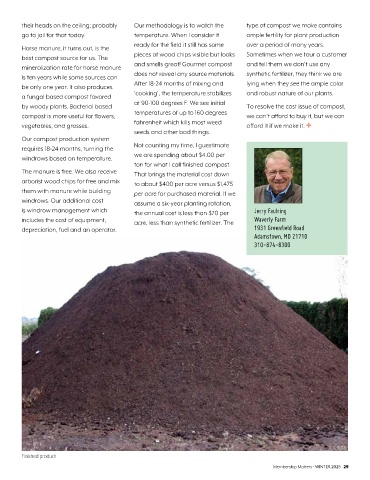
        Finished product

                                                                                             Membership Matters • WINTER 2025   29

