


Page 27 - MNLGA Free State Winter 2025
P. 27
went to my grandfather's barn yard                                         do it in the best manner we know.
        and hauled home cow manure from         Using organics                     Preparation is always the key to
        the very bottom of the pile for use in                                     success in any endeavor. The front-
        the garden. It was black and smelled    for agricultural                   loaded costs of using compost may
        good.                                   production is not new.             appear impractical but if we achieve

        Without consciously recalling those     Highly sustainable                 better growth rates and sustain
        events of my youth, we started                                             our soils over time, it may be less
        applying compost to our fields here     systems, such as the               expensive.
        at Waverly Farm in 2005. This came      "Farmers of Forty                  There are numerous good reasons
        about because I was convinced we                                           to spend the money up front. There
        were increasing winter damage by        Centuries" in China,               is only enough space here to discuss
        using synthetic fertilizer. I sought an   kept fields productive           three reasons briefly, but in fact they
        alternative system of nutrition and                                        are the three to discuss:
        general soil health. Knowing that       since as early as                  1. Soil replenishment. When we
        the salts of synthetic fertilizer can   2000 BCE using these                sell our soil with a plant, we sell
        degrade soil microbe populations,                                           about 250 tons per acre. We
        which in turn affects plant health,     methods.
                                                                                                   (continued on next page)
        I sought to reduce or eliminate the
        use of fertilizer. At the same time,
        we began using an Imants spading
        machine to prepare soil for planting
        and to incorporate compost. In
        combination we increased plant
        productivity; same plant increased
        productivity of 20% to 40% in the
        absence of fertilizer and reduced
        pruning.

        In the beginning the math looked
        like this. We used an application rate
        of approximately 100 tons per acre
        from Linden Farms Humus. It was a
        by-product of LeafGro production
        from Maryland Environmental. It cost
        $1,475.00 per acre for the material to
        be delivered to our yard. Assuming
        the average planting rotation is six
        years, the average annual cost for
        compost applied one time was $245
        per acre ($1,475.00 divided by 6).
        Longer rotations cost less per acre,
        and shorter rotations may allow for
        less compost.

        We only get one opportunity to plant
        our liners, and it makes sense to
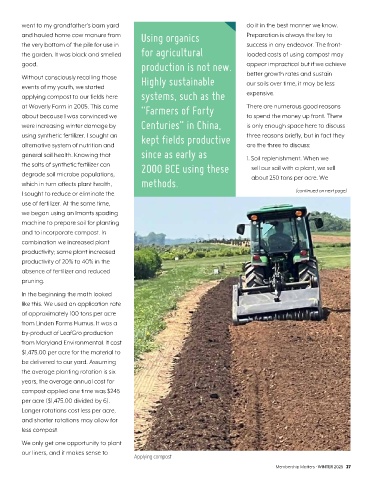
                                             Applying compost
                                                                                              Membership Matters • WINTER 2025   27

