


Page 252 - Destaco - Clamping Technology
P. 252
pneumatic power cylinders


      Features


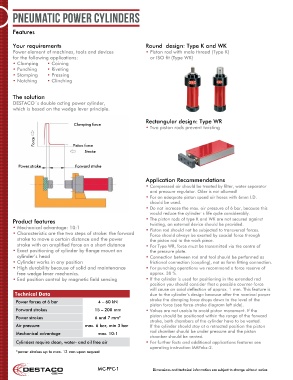
      Your requirements                                       Round  design: Type K and WK
      Power element of machines, tools and devices            •  Piston rod with male thread (Type K)
      for the following applications:                           or ISO fit (Type WK)
      • Clamping     • Coining
      • Punching     • Riveting
      • Stamping     • Pressing
      • Notching     • Clinching


      The solution
      DESTACO´s double acting power cylinder,
      which is based on the wedge lever principle.

                                                              Rectangular design: Type WR
                                Clamping force
                                                              •  Two piston rods prevent twisting

               Force           Piston force

                                    Stroke


         Power stroke           Forward stroke

                                                              Application Recommendations
                                                              •  Compressed air should be treated by filter, water separator
                                                                and pressure regulator. Oiler is not allowed!
                                                              •  For an adequate piston speed air hoses with 6mm I.D.
                                                                should be used.
                                                              •  Do not increase the max. air pressure of 6 bar, because this
                                                                would reduce the cylinder´s life cycle considerably.
      Product features                                        •  The piston rods of type K and WK are not secured against
                                                                twisting, an external device should be provided.
      • Mechanical advantage: 10:1                            •  Piston rod should not be subjected to transversal forces.
      •  Characteristic are the two steps of stroke: the forward   Force should always be exerted by coaxial force through
        stroke to move a certain distance and the power         the piston rod to the work piece.
        stroke with an amplified force on a short distance    •  For Type WR, force must be transmitted via the centre of
      •  Exact positioning of cylinder by flange mount on       the pressure plate.
        cylinder’s head                                       •  Connection between rod and tool should be performed as
      •  Cylinder works in any position                         frictional connection (coupling), not as form fitting connection.
      •  High durability because of solid and maintenance     •  For punching operations we recommend a force reserve of
        free wedge lever mechanics.                             approx. 30 %.
      •  End position control by magnetic field sensing       •  If the cylinder is used for positioning in the extended rod
                                                                  position you should consider that a possible counter-force
                                                                will cause an axial deflection of approx. 1 mm. This feature is
        Technical Data                                          due to the cylinder’s design because after the nominal power
                                                                stroke the clamping force drops down to the level of the
        Power forces at 6 bar             4 – 60 kN
                                                                piston force (see force-stroke diagram left side).
        Forward strokes                  15 – 200 mm          •  Valves are not usable to avoid piston movement. If the
        Power strokes                    6 and 7 mm*            piston should be positioned within the range of the forward
                                                                stroke, both chambers of the cylinder have to be vented.
        Air pressure                 max. 6 bar, min 3 bar      If the cylinder should stay at a retracted position the piston
        Mechanical advantage              max. 10:1             rod chamber should be under pressure and the piston
                                                                chamber should be vented.
        Cylinders require clean, water- and oil free air      •  For further facts and additional applications features see
                                                                  operating instruction MAPnkz-2.
        *power strokes up to max. 12 mm upon request


                                          MC-PPC-1               Dimensions and technical information are subject to change without notice

