


Page 722 - Demo
P. 722
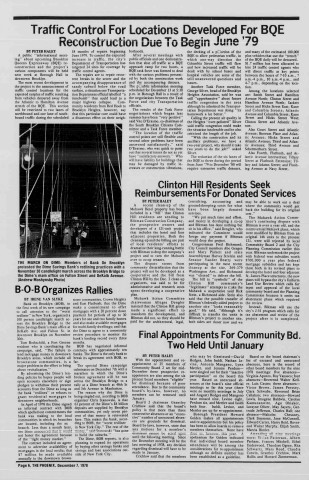
Traffic Control For LocationsReconstructioncations Developed For BQEDue To Begin June %u201979BY PETER HALEYA public %u201c informational meeting%u2019%u2019 about upcoming Brooklyn Queens Expressway (BQE) re %u00adconstruction and the project%u2019s various components will be held next week at Borough Hall in downtown Brooklyn.The most recent development in the project is the announcement of traffic control locations for the expected surplus of traffic resulting from vehicles detoured away from the Atlantic to Hamilton Avenue stretch of the BQE. This section will be restricted to two lanes of northbound and one lane of southbound traffic during the scheduled18 months of repairs beginning June 1979. To control the expected increase in traffic, the city%u2019s Department of Transportation has targeted 24 sites for coverage by traffic control agents.The repairs are to repair recurrent breaks in the sewer and the accompanying disappearance of sandy subsoil below the road surface, a situation one Transportation Department official labelled %u201c a timebomb%u2019%u2019 that could lead to a major highway collapse. Community residents from Red Hook to Brooklyn Heights, however, say that this particular cure could have a disastrous effect on their neighTHE MARCH ON DIME: Members of Bank On Brooklynprotested the Dime Savings Bank%u2019s redlining practices with aNovember 30 candlelight march across the Brooklyn Bridge tothe Dim e%u2019s main office on Fulton Street and DeKalh Avenue.(Andrew Moshynsky Photo)B-O-B Organizes RalliesBY IRENE VAN SLYKE stone communities, Crown Heights Bank on Brooklyn (BOB), in and East Flatbush; that the Dime the first week of its new campaign make a commitment to offer to call attention to the %u201c worst mortgages with a 20 percent down redliner%u2019%u2019 in New York, organized a payment for periods of up to 30 100 person candlelight march ac- years for one and two family homes ross the Brooklyn Bridge to the and also make available mortgages Dime Savings Bank%u2019s main office at for multi-family dwellings; and that DeKalb Ave. and Fulton St. in the Dime to agree to a community downtown Brooklyn on November review procedure to monitor the 30th. bank%u2019s lending record every threeTom Rothschild, a Fort Greene months, resident who is coordinating the BOB has negotiated informal campaign, said, %u201c The failure to contracts with approximately ten lend motrgage money in downtown banks. The Dime is the only bank to Brooklyn areas, which include all break its agreement with BOB, so brownstone communities, is a far.major problem in the effort to bring The special Dime campaign about revitalization.%u201d culminates on December 7th with aBy advertising the Dime%u2019s len- marathon in which the Dime%u2019s ding policies he hopes people will broken agreem ent will be run open accounts elsewhere or sign across the Brooklyn Bridge to a pledges to withdraw their present rally at a Dime branch at 48th St accounts from the Dime as long as and 5th Avenue in Manhattan, the bank \The reason why the Dime is grant residential m ortgages in being singled out, acording to BOB downtown neighborhoods. organizer Chris Stanowski, is thatIn April of 1978 the Dime signed 63 percent of the Dime%u2019s $4 billion an informal contract with BOB deposits are supplied by Brooklyn which spelled out commitments the communities, yet only seven perbank was making to the local cent of that money is reinvested communities in which its branches here. This makes the bank, accorare located, including the mi ding to BOB, the %u201c worst redliner branch. Less than a month later, in New York City.%u201d The rest of the the Dime announced that it would money,%u201d Stanowski \not honor the agreement because to build the suburbs.%u201d of the %u201c tight money market.%u201d The Dime, BOB reports, is alsoThe contract included an agree- planning to expand its operations ment to advertise availablility of by buying other savings banks and mortgages in the local media; that savings and loan associations out57 million be made available side of New York City, annually to the downtown brownbo rhoods.After several m eetings with public officials and one demonstration that shut off traffic at a BQE approach ramp for two hours, a BQE task force was formed to deal with the various problems presented by both the construction work and the accompanying detours. The pDublic information meeting scheduled for December 13 at 5:30 p.m. in Borough Hall is a result of the negotiations between the Task Force and city Transportation officials.The results of the Task Force negotiations which began last summer have been %u201c very positive%u201d said Vito D%u2019Erasmo, co-chairman of the South Brooklyn Citizens Committee and a Task Force member.%u201c The location of the traffic control points are still flexible and several other problems have been answered satisfactorily,%u201d said D%u2019Erasmo, who was quick to point out that several issues do not as yet have %u201c satisfactory answers.%u201d Who will have liability for buildings that may be damaged by traffic increases or construction vibrations,the decking of a pDortion of the BQE to allow pedestrian traffic, in which one-way direction the Columbia Street traffic will flow and how increased traffic will be dealt with by school buses and hospital vehicles are some of the still unanswered questions and issues.Another Task Force member, George Silver, head of the Brooklyn Heights Association, said he was still %u201c apprehensive%u201d about future traffic congestion in the area although he admitted the Transportation Department was doing %u201c its homework a lot better.%u201dCalling the present air quality in the Heights %u201cover-polluted%u201d Silver said traffic congestion could make the situation intolerable and he also criticized the length of the job.%u201c With the construction and its ancillary problems, we have a two-year project, why should it take two years to do the job?%u201d asked Silver.The reduction of the six lanes of the BQE to three during the period from June %u201979 to December %u201980 will require extensive traffic detours,and many of the estimated 100,000 plus vehicles that use the %u201ctrench%u201d of the BQE daily will be detoured. $1.7 million has been allocated to hire 24 traffic control agents who will direct traffic at key points between the hours of 7-10 a.m., 7 a.m.-4 p.m., 10 a.m.-4 p.m., and 4-7 p.m., depending on the location.Among the locations selected are: Smith Street and Hamilton Avenue North; Clinton Street and Hamilton Avenue North; Sackett Street and Hicks Street East; Kane and Columbia Streets; Atlantic Avenue and Columbia Street; Kane Street and Hicks Street West; Clinton Street and Atlantic Avenue.Also Court Street and Atlantic Avenue; Boerum Place and Atlantic Avenue; Hicks Street and Atlantic Avenue; Third and Atlantic Avenues; Third Avenue and Schermerhom Street.Also Fourth, Flatbush, and Atlantic Avenue intersection; Tillary Street at Flatbush Extension; Tillary and Adams Street; and Flushing Avenue at Navy Street.Clinton Hill Residents SeekReimbursements For Donated ServicesBY PETER HALEYA recent clean-up of the Mohawk Hotel property has been included in a %u201cbill%u201d that Clinton Hill residents are sending to Blitman Construction Company, the prospective owners and developers of a 121-unit project that includes the hotel and four adjacent properties. Both the cleaning-up and the billing are part of local residents%u2019 efforts to dramatize their long-running battle with Blitman to drop the company%u2019s project and to turn the Mohawk over to co-op tenants.The dispute stem s from community dissatisfaction that the project will not be developed as a cooperative and the bill from Clinton Hill by the Dec. 2 clean-up organizers, was said to be for administrative and research costs spent developing a cooperative plan.Mohawk Action Committee chairwoman Allegra Dengler insisted that the Clinton Hill group made a significant effort to transform the development, and Blitman did not, so they should be paid for the architectural, legal,consulting, accounting and groundskeeping costs for what have been largely donated services.%u201c We put much time and effort, and money in developing a co-op and Blitman has done nothing but sit in his office,%u201d said Dengler, who indicated the Committee would forego any payment if Blitman would drop the project.Congressman Fred Richmond, City Council members Abe Gerges and Mary Pinkett and state Assemblyman Harvey Strelzin and Senator Vander Beatty were participating in the most recent cleanup at the site, 369-379 Washington Ave., and Richmond was %u201c elected%u201d to deliver the bill.The bill is %u201c symbolic%u201d of the Clinton Hill com m unity%u2019s %u201c legitimate%u201d attempts to make the Mohawk a cooperative said Rick Stein, a Richmond aide. Stein also said that the possible transfer of Blitman%u2019s federally-aided project to another site %u201c looks reasonably good.%u201d He said, %u201c Although it%u2019s difficult to transfer the units in Blitman%u2019s project to another site, both sides are closer now and wemay be able to work out a deal where the community would get back the building for its original cost.%u201dThe Mohawk Action Committe e %u2019s continuing dispute with Blitman is over a year old, and the controversial Mohawk plans, which were modified by Blitman from an original 146 units to the present 121, were still rejected by local Community Board 2 and the City Planning Commission earlier this year. Blitman undertook the project with federal rent subsidies worth $700,000 a year plus federal mortgage subsidies and has kept them both in its revised plans to develop the hotel and four adjacent St. James Place structures, the new plans will bypass the city%u2019s Uniform Land Use Review which calls for input and approval of the local community board and the Planning Commission because it omits tax abatement plans which required the review.Instead, Blitman will use the city%u2019s J-51 program which calls for tax abatement and review of the project after it is completed.Final Appointments For Community Bd.Two Held Until JanuaryBY PETER HALEYWith the appointment and reappointment of 25 members of Community Board 2 set for midDecember three prospective reappointees are also among the six present board members %u201c eligible%u201d for dismissal because of poor attendance. Due to the community board%u2019s by-laws, however, no members can be removed until January.Board 2 chairman Grantley Crichlow said that the board%u2019s policy is that more than three consecutive absences or an %u201c excessive%u201d number of unexcused absences are grouinds for dismissal. Board by-laws, however, state that any motions for a m em ber%u2019sUlMI1155cil CcUlIHJl UC aucu upuiiuntil the following meeting. Since the December meeting will be the last meeting of 1978, any decision regarding dismissal will have to be made in January.Crichlow said that the memberswho may be dism issed%u2014David Hedges, John Isoldi, Nathan Levine, Antonia M angano, Lynn Mettler, and Jerome Perdum%u2014 were singled out for their %u201c inactive participation%u201d on the board this year. Based on unexcused absences at the board%u2019s nine official meetings so far this year (there were no monthly meetings in July and August) Hodges and Mangano have missed nine, Levine eight, Perdum six, and Mettler and Isoldi both four. Isoldi, Levine, and Mettler are up for re-appointment.Borough President Howard Golden makes all appointments and re-appointments but his policy has been to allow boards to remove members themselves. None haveJ --------- ---------- 1----- ------------------- i t - I %u201e A UW1IC OVJ> , UUVl'VfVl, til AO JVW1.spokesman for Golden indicated that individual board member attendance will be among the considerations for re-appointment although no definite number has been established as a guideline.Based on the board chairman%u2019s list of excused and unexcused absences, here is the record of other board members for the nine 1978 meetings: five absences%u2014 Virginia Apuzzo, Roy Vanasco; four absences%u2014Reverend Walter Keiler, Luis Castro; three absences%u2014 Victor Brown, Jam es Pressey, Clara Schwabe, Reverend Brian Callahan; two absences%u2014Howard Lewis, Imogene Baldwin, Carolyn Kamunanwire, Agu Obiakor, Lorayne Oliver, May Sayers, Gertrude Jefferson, Charles Hall; one absence%u2014Malcolm Chessney,Clark Simmons, Jane McConnell, Edward Carter, Harry Reid, Reverend V/alter Murphy, Elijah Smith, Marcia Rimler.Attending e!l ni%u00abp m ppt i n a%u00abwere: V i'ian Patterson, Albert Parham, Frances Mitchell, Ethel Underwood, Theodore Ogren, Rita Schwartz, Mary Reed, Claudia Corwin, Grantley Crichlow, Mark Hollis and Howard Zimmerman.Page 6, THE PHOENIX, December 7,1978


