


Page 724 - Demo
P. 724
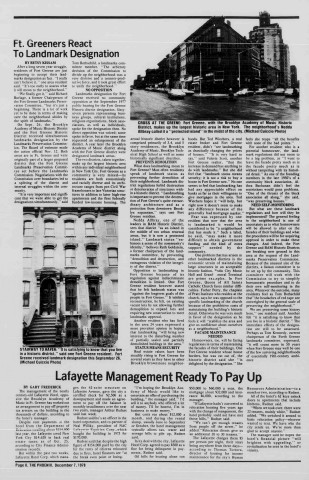
Ft. Greeners KeactTo Landmark DesignationCROSS AT THE GREENE: Fort Greene, with the Brooklyn Academy of Music HistoricDistrict, makes up the largest historic area in New York. The neighborhood's NeddaAllbray called it a %u201c protected island\BY BETSY KISSAMAfter a long seven year struggle, residents of Fort Greene are just beginning to accept their landmarks designation as fact. %u2018%u20181 really can't believe it,\said. \it will mean to the neighborhood.\%u2018%u2018We finally got it,\Burlage, a former Chairperson of the Fort Greene Landmarks Preservation Committee, \beginning. There is a lot of work yet to be done in terms of making sure the neighborhood abides by the spirit of landmarks.\On Sept. 26, the Brooklyn Academy of Music Historic District and the Fort Greene Historic District received simultaneous landm arks designation by the Landmarks Preservation Commission. The Board of estimate made the action official Nov. 12. Both areas are in Ft. Greene and were originally part of a larger proposed district that the Fort Greene Landmarks Preservation Committee set before the Landmarks Commission. Negotiations with the Commission over boundaries led to a splitting of the district and internal struggles within the community.\cant that we were able to get the designations simultaneously,%u201d saidTom Rothschild, a landmarks committee member. \decision of the Commission to divide up the neighborhood was a very divisive and a counter-productive force, and it took great effort to unify the neighborhood.%u201dNO OPPOSITIONLandmarks designation for Fort Greene received no community opposition at the September 1977 public hearing for the Fort Greene Historic district designation. Sixtyseven persons representing business groups, cultural institutions, religious organizations, block associations, as well as individuals, spoke for the designation then. No direct opposition was voiced; some spoke in favor, but at the same time requested an enlargement of the district. A year later the Brooklyn Academy of Music district along with the Fort Greene district were designated landmark areas.The two districts, taken together, make up the largest historic area within any individual neighborhood in New York City. Fort Greene as a community is very m ixed%u2014its residents are both economically and racially diverse and its architecture ranges from pre-Civil War framehouses to late Victorian structures in addition to later high-rise apartments and the first federally funded low-income housing. Theactual historic district however is comprised primarily of 3,4, and 5 story residences, the Brooklyn Academy of Music, Brooklyn Technical High School as well as some historically significant churches. PREVENTS DEMOLITIONWhat does landmarking mean to Fort Greene? Most often residents speak of landmark status as preventing further demolition of their neighborhood. Landmark district regulations forbid destruction or deterioration of structures within a historic district. %u201c Landmarking is important to prevent the destruction of Fort Greene's quite extraordinary architecture and as a protection from downtown Brooklyn expansion,%u201d says one Fort Greene resident.Nedda Allbray, one of the leaders in BAM Historic District, sees that district %u201c as an island in the middle of two urban renewal areas, but it is now a protected isla n d .\hances a sense of the community%u2019s identity,%u201d believes Ruth Goldstein, a former chairperson of the landmarks committee, by preventing \outrageous violation of the integrity of the district.%u201dOpposition to landmarking in Fort G reene because of its regulation against indiscriminate demolition is limited. One Fort Greene resident however stated that he felt landmark status was \people in Fort Greene.%u201d It inhibits reconstruction, he felt, on existing vacant lots by not allowing further demoplition to expand lots and requiring new construction to meet landmarks approval.Another resident who has lived in the area 24 years expressed a more prevalent opinion in hoping that landmarking \interest to the disturbing number of partially sealed and partially demolished buldings in the area.%u201d STATUS MEANS SECURITYReal estate values have been steadily rising in Fort Greene for several years as they have in other Brooklyn brownstone neighborhoods. But Ted Wiechers, a real estate broker and Fort Greene resident, didn%u2019t \as drastically changing the prices of houses.%u201d %u201c It is very hard to say,%u201d said Valerie Scott, another Fort Greene realtor, %u201cthat the increase in demand has anything to do with landmarks.%u201d But she did feel that %u201c landmark status means security; it is not a risk to buy a house in Fort Greene now.%u201d No one seems to feel that landmarking has had any appreciable effect on banks as far as their willingness to give mortgages in the area. Ted Wiechers hopes it \right now it doesn%u2019t seem to make any difference because of the generally bad m ortgage market.%u201d Fear was expressed by one resident that now that the area is landm arked it would be considered to be %u201c a neighborhood that has made it.%u201d Such a label, he said, %u201c may make it more difficult to obtain governm ent funding and the kind of extra su p p o rt\needed by the community.One problem that has arisen in other landmarked districts is the economic strain of m aintaining large structures in an acceptable historic fashion. Dadio City Music Hall and Grand entral Terminal are prime examples. In Fort Greene, Queen of All Saints Catholic Church faces similar difficulties. Father Perry, the chaplain of Pratt Institute who resides at the church, says he was opposed to the specific landmarking of the church because of the prohibitive costs of maintaining the building%u2019s historic detail. Otherwise he was very much in favor of the designation as he feels it will %u201c stabilize the area and give us confidence about ourselves as a neighborhood.%u201dFACADE MAINTENANCENEEDEDHomeowners, too, will be facing regulations in terms of maintaining the facades of their buildings. One Fort Greene resident whose house borders, but was cut out of, the historic district said she %u201c is delighted by the designation.%u201d Shefeels she reaps %u201c all the benefits with none of the bad points.%u201dFor another resident who is a potential homeowner, the landmark regulations did not seem to be a big problem, as \leave the facade pretty much as is the facade pretty much as is without tampering with its historical detail.%u201d As one of the founding members in the late 1950%u2019s of a community block association, Althea Buchanan didn%u2019t feel the restrictions would pose problems. \association all along,%u201d she said, \NEED SELF-MONITORINGBut what are these landmark regulations and how will they be implemented? The general feeling in the neighborhood is one of uncertainty as to what homeowners will be allowed to alter on the facades of their buildings and what the procedures will be for acquiring approval in order to make these changes. And indeed, the Fort Greene and BAM Historic Districts are breaking new ground in this area at the request of the Landmarks Preservation Commission. Because of the unusual size of the districts, a liaison committee is to be set up by the community. This committee will work with the Commission to try to simplify bureaucratic procedure and to do their own self-monitoring in the area. Whatever the outcome, many residents feel as Tom Rothschild that%u201d the headaches of red tape are outweighed by the general scale of preserving the neighborhood.%u201dWe are preserving some history here,%u201d one resident said. Another felt %u201c it is satisfying to know that you live in a historic district.%u201d The immediate effects of the designation are still to be asssessed. Perhaps as Tom Kennedy, current chairperson of the Forth Greene landmarks committee, expressed, \when Fort Greene may well be one of the few surviving neighborhoods of essentially 19th-century ambienceSTAIRWAY TO HAVEN: %u201c It is satisfying to know that you livein a historic district,\Greene received landmark designation this September 26.(Michael Cuiccio Photo)Lafayette Management Ready To Pay UpBY GARY FREDERICKThe management of the nearly century-old Lafayette Hotel, opposite the Brooklyn Academy of Music in Ft. Greene has worked out an arrangement to pay off property tax arrears on the building in the thousands of dollars, according to the hotel%u2019s manager.Despite rent payments m the hotel from the Department of Relocation totalling about 5154,900 last year, the Lafayette owed New York City $14,628 in back real estate taxes as of Oct. 25, according to City Finance Administration records.But within the past two weeks, Lafayette Hotel Corp. which manages the 62-suite structure on Lafayette Avenue, gave the city a certified check for $2,500 as a downpayment and made an agreement to pay off the balance in monthly installments over the next two years, manager Arthur Rudnet said last week.Rudnet said he%u2019s an officer in the hotel corporation, and co-partner of Neal Williky, president of NAC ^afavpttp Fnuities Coro..which bought the building in 1973 for $170,000.Rudent said that despite the high figure of $154,000 paid by the city for the rents of citizens relocated due to fires, hotel finances are %u201c at the break even point or losing.\demy of Music would like to entertain an offer of purchasing the building,%u201d the manager said.%u201d I%u2019d sell it to anybody who offered a lot of money. I%u2019ll be honest, I%u2019m in business to make money.%u201dBut costs run about $12,000 a month, and during the rental slump, usually June to September or October, the hotel management typically allows tax, water and sewage bills to pile up, Rudnet said.In its deal with the city, Lafayette Hotel Corp. agreed to pay $500 as a fine for being delinquent in payments, Rudnet said.Oil bills for heating alone run$50,000 to $60,000 a year, the mortgage about $32,000 and insurance $6,000, according to the manager.\relocation housing five years ago with the change of mangement, the hotel probably could not have met those bills,%u201d Rudnet said.\from people off the street,%u201d he added.\an additional 20 to 30 tenants.%u201dThe Lafayette charges them $5 per person per night, their stays being anywhere from three days%u2014 according to Thomas Tortora, director of housing for income maintenance for the city%u2019s HumanResources A dm inistration%u2014to a month or two, according to Rudnet.All of the hotel%u2019s 62 keys unlock doors to apartments that include kitchens, Rudnet said.%u201c When we took over, there were 22 tenants, mainly white,%u201d Rudnet added. \basic relocation policy%u2014whoever wanted to rent. We have who the city sends us. We%u2019re more than glad to accept anyone.%u201dThe manager said he hopes tne hotel%u2019s financial picture %u2018%u2018will brighten with upg rad in g ,\revitalization he sees in the hotel%u2019s vicinity.Page 8. THE PHOENIX, December 7,1978


