


Page 49 - Demo
P. 49
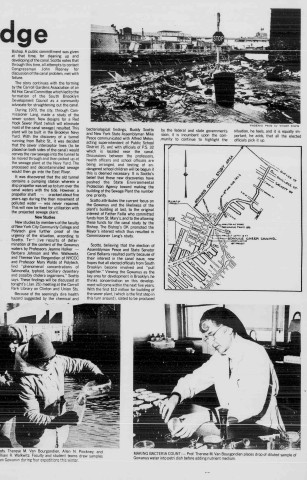
Bishop. A public committment was given at that time, for cleaning up and developing of the canal. Scotto notes that through this time, all attempts to contact Congressman John Rooney for discussion of the canal problem, met with failure.The story continues with the forming by the Carroll Gardens Association of an Ad Hoc Canal Committee which led to the formation of the South Brooklyn Development Council as a community advocate for straightening out the canal.During 1970, the city, through Commissioner Lang, made a study of the sewer system. New designs for a Red Hook Sewer Plant (which will eliminate most of the canal sewage) resulted. This plant will be built in the Brooklyn Navy Yard. With the discovery of a tunnel running from Baltic St., it was decided that the sewer interceptor lines (to be placed on both sides of the canal) would convey the raw sewage into the tunnel to be moved through and then picked up at the sewage plant at the Navy Yard. The processed and decontaminated sewage would then go into the East River.It was discovered that the old tunnel contains a pumping station wherein a ship propellor was set up to turn over the canal waters with the tide. However, a propellor shaft %u2014 cracked about five years ago during the then movement of polluted water %u2014 was never repaired. This will now be fixed for utilization with the projected sewage plant.New StudiesNew studies by members of the faculty of New York City Community College and Polytech give further proof of the urgency of the situation, according to Scotto. Te--* jive results of determination of the content of the Gowanus waters by Professors Jeanne Holker %u2014 Barbara Johnson and Wm. Walkowitz, and Therese Van Borgandien of NYCCC and Professor Mary Waldo of Polytech, find %u201c phenomenal concentrations of Salmonella, typhoid, bacillary dysentery and possibly cholera organisms,%u201d Scotto says. These findings will be discussed at tonight%u2019s (Jan. 25) meeting at the Carroll Park Library on Clinton and Union Sts.Because of the seemingly dire health hazard suggested by the chemical andv m , M,**u*t M i lbacteriological findings, Buddy Scotto and New York State Assemblyman Mike Pesce communicated with Alfred Melov, acting superintendent of Public School District 15, anc' with officials of P.S. 32 which is located near the canal. Discussions between the professors, health officers and school officials are being arranged, and testing of endangered school children will be begun if this is deemed necessary. It is Scotto's belief that these new discoveries have pushed the State Environmental Protection Agency toward making the building of the Sewage Plant the number one priority.Scotto attributes the current focus on the Gowanus and the likeliness of the plant%u2019s building at last, to the original interest of Father Failla who committed funds from St. Mary's, and to the allowing these funds for the canal study by the Bishop. The Bishop%u2019s OK promoted the Mayor%u2019s interest which thus resulted in Commissioner Lang%u2019s study.Scotto, believing that the election of Assemblyman Pesce and State Senator Carol Bellamy resulted partly because of their interest in the canal issue, now hopes that all elected officials from South Brooklyn become involved and %u2018%u2018pul! together.%u201d Viewing the Gowanus as the key area for development in Brooklyn, he thinks concentration on this development will come within the next five years. With the first $12 million for building of the sewer plant, (which is the first step in this turn around), slated to be producedby the federal and state governments soon, it is incumbent upon the comimunity to continue to highlight theP H O E N IX Photo by V incent Smortosituation, he feels, and it is equally important, he adds, that all the elected officials pick it up.ofs. Therese M. Van Bourgondien, Allen N. Pinckney, and lliam R. Walkwitz. Faculty and student teams drew samples %u201c cwanus during four expeditions this winter. n f t I I u u %u00bbMAKING BACTERIA COUNT:%u2014 Prof. Therese M. Van Bour gondien places drop of diluted sample of Gowanus water into petri dish before adding nutrient medium.


